

 DEFENCE INDUSTRYBrahMos export orders: Vietnam deal worth about $100 million, Indonesia $200 million as Akash reaches Tajikistan, Turkmenistan
 DEFENCE INDUSTRYMahindra Embraer Nagpur facility to assemble C-390 if IAF picks the aircraft
 DEFENCE INDUSTRYSMPP Drone Manufacturing Push: Firm Shifts From Ammunition to Unmanned Warfare, Targets Integrated Defence Capabilities
 INDIA DEFENCEDhruv NG Helicopter Explained: What HAL Has Actually Put Into Pawan Hans Service
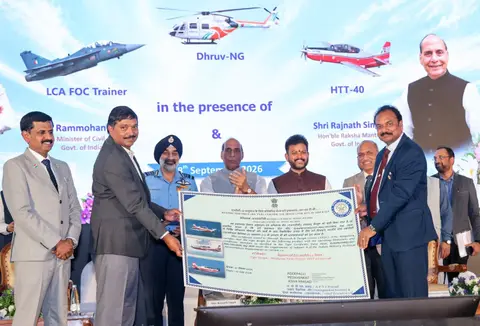 INDIA DEFENCELCA FOC Trainers Delivered With HTT 40 and Dhruv NG as Rajnath Singh Asks Engineers for Technologies That Do Not Exist
Rajnath Singh Sri Lanka visit dates are set for the first week of September, when the Defence Minister travels to Colombo to review the full and timely implementation of the India-Sri Lanka Defence Cooperation MoU signed in April 2025. It will be his first visit to the island nation in his capacity as Defence Minister.
Singh is expected to hold talks with President Anura Kumara Dissanayake, who also holds the defence portfolio, and with Prime Minister Harini Amarasuriya. He is due to meet Air Vice Marshal (Retd) Sampath Thuyacontha, Secretary to Sri Lanka's Ministry of Defence, and separately with the commanders of the Sri Lankan Army, Navy and Air Force over the course of a two day stay.
What the Rajnath Singh Sri Lanka visit is expected to cover
The trip centres on pushing forward an agreement that has moved slowly since it was signed. Defence sources said the Defence Cooperation MoU covers joint military exercises, capacity building across domains, cooperation in humanitarian assistance and disaster relief, an increase in naval port calls by both countries, and the exploration of defence industry collaboration.
The MoU runs for five years. Either side can walk away from it with three months' notice, or extend it for a further three years once the term lapses. Its full text has not been made public by either government, and defence sources said the review in Colombo is meant to convert the framework into scheduled activity rather than reopen its terms.
The document behind the visit
The Defence Cooperation MoU was one of seven bilateral documents exchanged when Prime Minister Narendra Modi visited Colombo in April 2025, alongside agreements on energy, digital cooperation and multi-sectoral grant assistance for Sri Lanka's Eastern Province. It was signed on the Indian side by Foreign Secretary Vikram Misri and on the Sri Lankan side by AVM Thuyacontha, and it marked the first time the two countries had put their defence relationship into a standalone framework document rather than a set of standing arrangements built up case by case.
Foreign Secretary's Colombo trip laid the groundwork
The visit follows a run of high level contact between the two capitals. Misri travelled to Colombo on 5 August for a one day visit, calling on President Dissanayaka, Prime Minister Amarasuriya and Foreign Minister Vijitha Herath, according to the High Commission of India in Colombo. The two sides reviewed ongoing bilateral initiatives and reaffirmed Sri Lanka's place in India's Neighbourhood First policy.
Preparations for Singh's own trip are already under way on the ground. India's High Commissioner to Sri Lanka, Santosh Jha, accompanied by the mission's defence adviser and deputy defence adviser, met AVM Thuyacontha on 14 August specifically to work through arrangements for the visit, according to people familiar with the planning.
The Rajnath Singh Sri Lanka visit itinerary has not been finalised. Singh is expected to hold his principal engagements in Colombo, with a possible stop at Trincomalee, the natural deep water harbour on Sri Lanka's east coast that has figured in Indian strategic thinking on the island since a 1987 understanding that it would not be used by third countries in ways that threaten India's security interests.
A relationship rebuilt since a cancelled 2023 trip
Singh was originally due in Colombo in September 2023, on a visit the government called off at short notice for what it described then as unavoidable circumstances. The trip now planned would be the most senior Indian defence engagement with the island since that cancellation.
The intervening years carried the relationship forward anyway. The 2023 defence dialogue laid the basis for the MoU, Modi's own visit delivered it in April 2025, and India and Sri Lanka's defence contacts today rest on considerably more than that single document. Joint exercises such as SLINEX and Mitra Shakti run on a regular cycle, Sri Lankan officers train at Indian military academies, and naval port calls between the two countries have become routine rather than occasional. Humanitarian assistance and disaster relief cooperation, hydrography and, more recently, cyber security have been layered onto a relationship that traces its structured form back to the 1980s, when the Indian Peace Keeping Force deployed to the island during the conflict with the LTTE.
The Indian Ocean context behind the timing
The renewed push for implementation lands against a wider regional backdrop. Chinese research vessels and submarines calling at Sri Lankan ports have been a recurring concern for New Delhi, and India has previously sought and received assurances from Colombo that Sri Lankan territory will not be used in ways inimical to Indian security. That assurance formed part of the joint statement issued when Dissanayaka visited India in December 2024, five months before the MoU itself was signed, and it sits alongside the wider case Defence Minister Singh has made this year for India as the primary guarantor of peace and stability across the Indian Ocean Region.
Sri Lanka occupies a central place in India's Neighbourhood First policy, visible elsewhere this year in Modi's state visit to Seychelles, and in the newer MAHASAGAR framework for maritime security and growth across the region. The same competitive backdrop runs through New Delhi's other Indo-Pacific partnerships, including the renewed defence declaration signed with Australia in Melbourne. The Sri Lanka MoU was framed by both governments at signing as a way of giving that relationship a standing vehicle, rather than leaving it to individual port calls and exercises to carry the weight.
Singh's visit will be the first opportunity at defence minister level to test how much of that framework has moved from text to practice since April 2025. The three service commanders' meetings are expected to produce the clearest sense of where joint training and capacity building stand.
COMMENTS
JOIN THE DISCUSSION