
 INDIA DEFENCEDhruv NG Helicopter Explained: What HAL Has Actually Put Into Pawan Hans Service
 INDIA DEFENCELCA FOC Trainers Delivered With HTT 40 and Dhruv NG as Rajnath Singh Asks Engineers for Technologies That Do Not Exist
 DEFENCE INDUSTRYTata Zorawar light tank clears Army's L1 hurdle for Rs 20,000 crore contract
 DEFENCE INDUSTRYIndia Belgium Defence Deals Sealed As PM De Wever Visits Delhi
 DEFENCE INDUSTRYAero India 2027 Dates Confirmed for February 8 to 12 in Bengaluru
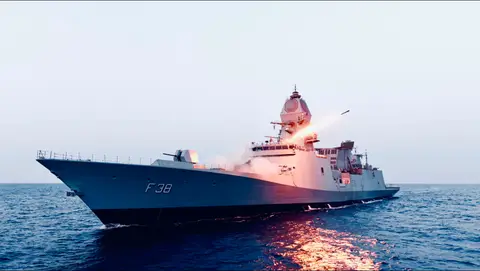
The Visakhapatnam-class are guided-missile destroyers built under Project 15B, representing among the most capable surface combatants of the Indian Navy. An evolution of the earlier Kolkata-class (Project 15A), these ships incorporate improved stealth features, updated sensors and a high degree of automation. They are constructed at Mazagon Dock Shipbuilders (MDL) in Mumbai and carry a large proportion of indigenous content, reflecting the growing maturity of Indian warship design.
Weapons and sensors
As multi-role destroyers, the Visakhapatnam-class are designed to fight across all three dimensions of naval warfare: against surface ships, aircraft and submarines. Their offensive punch centres on supersonic anti-ship and land-attack cruise missiles, while long-range surface-to-air missiles provide fleet air defence over a wide area. These systems form part of the broader inventory examined under missiles in India. A main gun, close-in weapon systems, torpedoes and rocket launchers round out an armament suited to both high-intensity conflict and lower-level maritime security tasks.
Advanced radars and combat management systems allow the ships to track numerous targets simultaneously and coordinate the defence of an entire task group. A modern destroyer functions as much as a floating command-and-control node as a weapons platform, fusing data from its own sensors and from other units into a single picture. This makes the class a natural escort for high-value units such as the aircraft carriers INS Vikrant and INS Vikramaditya, whose air wings they help protect while the carriers project power ashore and at sea.
Role and significance
Destroyers sit near the top of the surface fleet hierarchy, combining endurance, firepower and command facilities in a single hull. The Visakhapatnam-class can lead a task group, provide air defence for other ships, and strike targets at sea or ashore with its cruise missiles. Their embarked helicopters extend sensor reach and add anti-submarine capability, complementing dedicated platforms such as the Kamorta-class corvettes and knitting the surface force into a coherent whole.
The programme underscores the depth of Indian warship design and construction. Building destroyers of this sophistication domestically requires integrating a vast array of weapons, sensors, machinery and combat systems, much of it sourced from Indian firms across the country. Each ship represents millions of hours of design, fabrication and testing, and the supply relationships built along the way strengthen the industrial base that supports the entire spectrum of the Navy's warships. This reduces dependence on foreign suppliers for critical capabilities and keeps design authority within the country.
The ships are being inducted progressively, each successive vessel benefiting from lessons learned during the construction and trials of its predecessors. Refinements in stealth shaping, systems integration and habitability accumulate across the class, so that later ships are quietly better than the first. Alongside next-generation frigates such as the Nilgiri-class, the Visakhapatnam-class forms the backbone of a modern, blue-water surface fleet capable of sustained operations across the Indian Ocean Region.
Their combination of stealth, firepower and networked situational awareness reflects a deliberate shift toward larger, more survivable and more heavily armed combatants. Designed to operate as both the shield and the sword of Indian carrier battle groups, these destroyers embody the Navy's ambition to field a balanced, self-reliant fleet able to defend the nation's maritime interests well into the coming decades. Their long endurance and generous magazines allow them to remain on station far from base, sustaining presence over extended deployments in distant waters. As successive ships of the class join the fleet and their crews accumulate operational experience, the Visakhapatnam-class is expected to serve as the reference standard against which future indigenous surface combatants are measured, setting the benchmark for firepower, stealth and systems integration in the surface force.