
 INDIA DEFENCEDhruv NG Helicopter Explained: What HAL Has Actually Put Into Pawan Hans Service
 INDIA DEFENCELCA FOC Trainers Delivered With HTT 40 and Dhruv NG as Rajnath Singh Asks Engineers for Technologies That Do Not Exist
 DEFENCE INDUSTRYTata Zorawar light tank clears Army's L1 hurdle for Rs 20,000 crore contract
 DEFENCE INDUSTRYIndia Belgium Defence Deals Sealed As PM De Wever Visits Delhi
 DEFENCE INDUSTRYAero India 2027 Dates Confirmed for February 8 to 12 in Bengaluru
Guided and extended-range artillery rounds are advanced munitions designed to increase both the reach and the accuracy of conventional artillery. Rather than replacing guns, these projectiles multiply the effectiveness of existing platforms, allowing a single accurate round to achieve what once required many. Their development is a central strand of the modernisation of Indian artillery systems and reflects a global shift in land warfare towards precision fires.
Traditional artillery is an area weapon: shells are fired in numbers to saturate a target zone, accepting a wide dispersion. Precision-guided munitions change this by incorporating navigation and control, allowing a shell or rocket to be steered towards its target with far greater accuracy. Extended-range projectiles, meanwhile, use improved aerodynamics, base-bleed or rocket-assist techniques to fly further than standard rounds. Combining the two produces munitions that are both accurate and long-reaching, transforming how artillery is employed and allowing gunners to hold distant, fleeting or high-value targets at risk that older ammunition could not reliably reach.
Types of advanced munitions
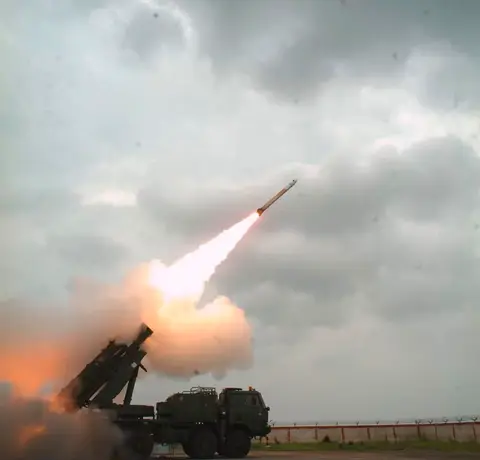
Several categories of advanced round are relevant to the Indian Army. Precision-guided 155mm shells use guidance packages to correct their flight, greatly reducing the miss distance compared with unguided rounds. Extended-range shells use aerodynamic and propulsion enhancements to increase reach without sacrificing lethality. Guided rocket variants, such as those developed for the Pinaka MBRL, bring similar precision to rocket artillery. Across all these types, the aim is to deliver the right effect on target with fewer rounds and less risk to friendly forces and civilians.
These munitions are designed to be compatible with the Army's family of 155mm guns, which have been progressively standardised on a single calibre precisely so that a common family of advanced munitions becomes practical. When a single round type can be fired from many different guns, supply, training and stockpiling are all simplified, and the benefit of each new munition is spread across the whole fleet rather than tied to one platform. This commonality is one of the strongest arguments for the long effort to standardise the artillery arm on 155mm.
Development and significance
Work on guided and extended-range munitions in India is being pursued by DRDO in conjunction with domestic industry, and it should be understood as an area of active development and trials rather than a fully mature, fielded capability across all types. Precision munitions are technically demanding, requiring rugged guidance electronics that can survive the extreme forces of gun launch, reliable navigation, and accurate targeting data from surveillance systems. Progress in these areas depends on parallel advances in sensors, electronics and the wider defence-industrial base, and on the ability to manufacture such rounds at acceptable cost and in useful quantity.
The significance of these munitions is considerable. Precision reduces the logistical burden of artillery by cutting the number of rounds required for a given effect, and it enables the engagement of targets that would otherwise demand air power or missiles. It also limits unintended damage, an increasingly important consideration in modern operations where proportionality and the protection of civilians are closely scrutinised. For the Regiment of Artillery, the ability to deliver accurate fire at extended range transforms guns and rockets into precise, long-reaching instruments rather than purely area weapons. As these munitions mature and enter service in greater numbers, they will complete the transformation of India's artillery from a force focused on volume of fire to one capable of precision at depth, and their continued indigenous development remains a priority in the drive towards a self-reliant and technologically advanced artillery arm. Achieving that goal depends on close cooperation between the research establishment, the ammunition industry and the gunners who will employ the rounds, so that the munitions delivered match real operational needs rather than laboratory ideals.