
 INDIA DEFENCEDhruv NG Helicopter Explained: What HAL Has Actually Put Into Pawan Hans Service
 INDIA DEFENCELCA FOC Trainers Delivered With HTT 40 and Dhruv NG as Rajnath Singh Asks Engineers for Technologies That Do Not Exist
 DEFENCE INDUSTRYTata Zorawar light tank clears Army's L1 hurdle for Rs 20,000 crore contract
 DEFENCE INDUSTRYIndia Belgium Defence Deals Sealed As PM De Wever Visits Delhi
 DEFENCE INDUSTRYAero India 2027 Dates Confirmed for February 8 to 12 in Bengaluru
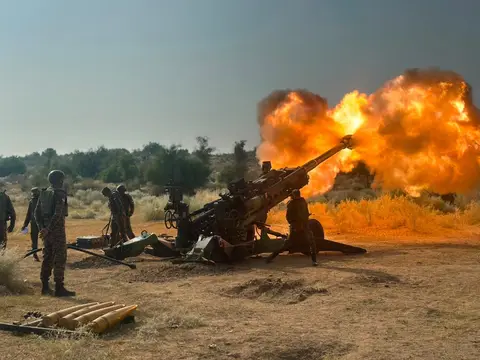
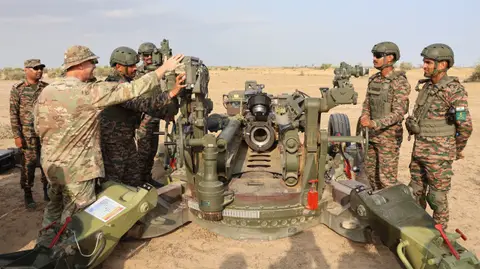
The M777 is a 155mm/39-calibre ultra-light towed howitzer of United States origin, acquired by India specifically to provide air-mobile firepower in high-altitude and mountainous terrain. Its defining characteristic is exceptionally low weight for a 155mm gun, achieved through extensive use of titanium and aluminium alloys, which allows it to be lifted by helicopter into positions that heavier guns cannot reach. The M777 has become a key element of the Indian Army's mountain artillery and part of the modern spectrum of Indian artillery systems.
India selected the M777 to address a specific operational need: delivering 155mm firepower in the demanding conditions along the northern borders and the Line of Actual Control (LAC), where terrain and altitude make the movement of conventional artillery difficult. The gun was acquired through a government-to-government arrangement with the United States, with a portion of the programme involving assembly and integration work in India in partnership with domestic industry, linking it to the wider defence manufacturing ecosystem and giving Indian firms experience with an advanced gun.
Design and mobility
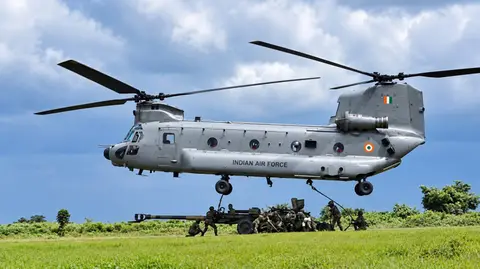
Weighing far less than a conventional towed 155mm gun, the M777 can be under-slung and transported by medium-lift helicopters, giving commanders the ability to rapidly deploy and reposition artillery in the mountains. This air-portability is its principal advantage. The gun uses a 155mm/39-calibre barrel and a digital fire-control system that supports rapid and accurate laying, and it is compatible with standard NATO-pattern 155mm ammunition as well as precision-guided rounds. Its titanium structure combines strength with light weight, though it demands careful handling and specialised maintenance to preserve the airframe-grade components.
The trade-off for its light weight is a shorter barrel length than the 155mm/52 guns, which give those systems greater range on flat terrain. In the mountains, however, the M777's ability to reach otherwise inaccessible firing positions can be more valuable than raw range, and its compatibility with guided munitions further enhances its effectiveness. Positioned high on a ridge or in a valley that a heavier gun could never occupy, the M777 can bring accurate fire to bear where it matters most, supporting infantry on ground that would otherwise lie beyond the reach of artillery.
Operational role
Deployed primarily in the high-altitude sectors, the M777 gives mountain formations organic 155mm support that can be moved by air as the situation demands. This mobility is particularly significant in terrain where roads are limited and vulnerable, and where the ability to shift firepower quickly can be decisive. The gun operates alongside other systems in the Regiment of Artillery, forming part of a layered artillery capability tailored to the theatre and complementing heavier towed and self-propelled guns used elsewhere.
The M777's compatibility with 155mm precision munitions makes it a natural platform for guided extended-range rounds, allowing a light gun to deliver accurate fires at distance. This combination of air-mobility and precision is well suited to mountain warfare, where targets may be dispersed and difficult to engage with area fire, and where every round carried up to altitude is precious. The acquisition of the M777 reflects a pragmatic approach to artillery modernisation: importing a specialised capability that fills a clear operational gap while indigenous programmes mature. As one of the few dedicated ultra-light 155mm guns in the world, the M777 provides the Indian Army with a distinctive tool for the mountains, complementing the heavier, longer-ranged systems that dominate the plains and desert sectors and rounding out a modern, multi-terrain artillery force capable of operating from the deserts of the west to the high Himalayas. Its induction has also given Indian crews and maintainers valuable experience with a modern imported gun, knowledge that feeds back into how the force operates and sustains its wider fleet of 155mm weapons.