
 INDIA DEFENCEDhruv NG Helicopter Explained: What HAL Has Actually Put Into Pawan Hans Service
 INDIA DEFENCELCA FOC Trainers Delivered With HTT 40 and Dhruv NG as Rajnath Singh Asks Engineers for Technologies That Do Not Exist
 DEFENCE INDUSTRYTata Zorawar light tank clears Army's L1 hurdle for Rs 20,000 crore contract
 DEFENCE INDUSTRYIndia Belgium Defence Deals Sealed As PM De Wever Visits Delhi
 DEFENCE INDUSTRYAero India 2027 Dates Confirmed for February 8 to 12 in Bengaluru
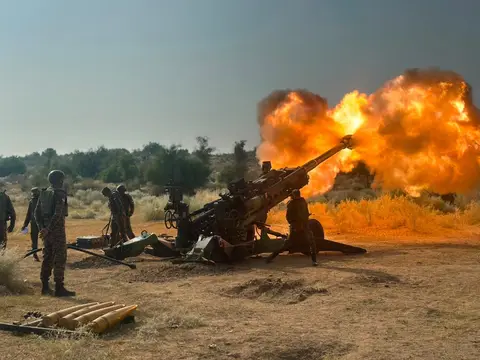
The K9 Vajra is a 155mm/52-calibre tracked self-propelled howitzer in service with the Indian Army, representing one of the largest artillery procurement and manufacturing programmes undertaken in the country. Derived from the South Korean K9 Thunder, the Vajra is assembled in India by Larsen & Toubro with substantial indigenous content, and it forms a core part of the Army's drive to field mobile, protected firepower capable of keeping pace with mechanised formations. It sits within the wider family of Indian artillery systems that have been modernised since the 2010s.
Unlike a towed gun that must be unlimbered before firing, a self-propelled howitzer carries its crew, ammunition and fire-control equipment inside a tracked, armoured hull. This allows the K9 Vajra to move rapidly into position, fire and displace before counter-battery fire can respond, a capability often described as 'shoot-and-scoot'. The gun is optimised for the flat, open terrain of India's western desert sector, where its mobility and 155mm firepower complement the armoured and mechanised units of the Indian Army. Its protected hull also shields the detachment from small-arms fire and shell splinters, allowing the gun to operate closer to the forward edge of battle than an exposed towed piece could.
Design and capabilities
The Vajra mounts a 155mm/52-calibre ordnance, the calibre length that has become the modern standard for extended range. It carries an onboard ammunition load, an automated loading assist system and a modern fire-control suite, enabling rapid engagement of targets. As a tracked platform it offers cross-country mobility and protection for the crew against small-arms fire and shell splinters. Reported ranges for 155mm/52 guns vary with the type of projectile and charge used, with standard rounds reaching well beyond the older 130mm and 105mm guns the Army has historically operated. The combination of a high rate of fire, rapid displacement and an armoured platform makes the gun well suited to fast-moving operations in which artillery must move with the manoeuvre force rather than lag behind it.
The programme is notable for its high degree of localisation. Larsen & Toubro established a dedicated production facility, and a large proportion of the system is manufactured domestically, supporting the broader ecosystem of defence manufacturing in India. This model of licensed production with progressive indigenisation has been cited as a template for future artillery and armoured vehicle programmes, and it has helped build a domestic supply chain of components and skills that can be applied to other platforms. Sustaining such a line requires steady orders, and the workforce and tooling developed for the Vajra represent a national asset in their own right.
Service and high-altitude role
The K9 Vajra was originally acquired primarily for the desert sector, but following heightened tensions along the northern borders the Army reportedly deployed and evaluated the platform in high-altitude, cold-weather conditions. Adapting a self-propelled gun for such environments involves winterisation of the engine, hydraulics and electronics, and the induction of the Vajra in these theatres reflects the Army's intent to field responsive firepower across varied terrain. Additional orders have reportedly been placed to expand the fleet, underscoring the platform's central place in artillery modernisation and providing continuity of work for the domestic production line.
Within the combined-arms structure of the Regiment of Artillery, the K9 Vajra provides the self-propelled component that operates alongside towed guns and rocket systems to give commanders a layered set of options for close support and deep fires, matched to the terrain and the nature of each operation. The Vajra also serves as a growth platform: as India develops guided and extended-range artillery rounds, self-propelled 155mm guns are natural carriers for such precision munitions, further increasing the reach and accuracy of the fleet. The K9 Vajra therefore stands not only as a proven in-service system but as a foundation for the next phase of India's tube-artillery modernisation, combining protected mobility, indigenous manufacture and the standard 155mm calibre that now defines the Army's gun programmes.