
 INDIA DEFENCEDhruv NG Helicopter Explained: What HAL Has Actually Put Into Pawan Hans Service
 INDIA DEFENCELCA FOC Trainers Delivered With HTT 40 and Dhruv NG as Rajnath Singh Asks Engineers for Technologies That Do Not Exist
 DEFENCE INDUSTRYTata Zorawar light tank clears Army's L1 hurdle for Rs 20,000 crore contract
 DEFENCE INDUSTRYIndia Belgium Defence Deals Sealed As PM De Wever Visits Delhi
 DEFENCE INDUSTRYAero India 2027 Dates Confirmed for February 8 to 12 in Bengaluru
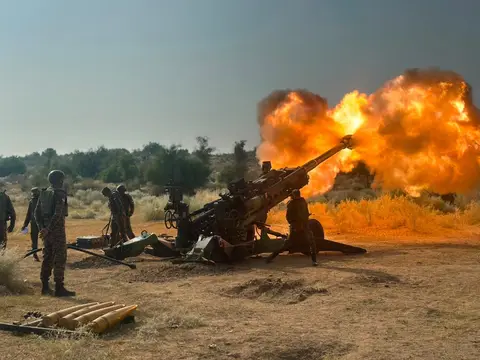
The Regiment of Artillery is the fire-support arm of the Indian Army and one of its largest combat arms. It provides the massed and precise firepower that supports infantry and armoured operations, and it operates the full range of Indian artillery systems, from towed and self-propelled guns to rocket launchers and, historically, surface-to-surface missiles. As a combined body of gunners, the Regiment traces its lineage back through the pre-independence army and has evolved into a modern, multi-layered force.
Artillery has long been described as the arm that delivers the decisive weight of fire in battle, and the Regiment's role is to concentrate that firepower where and when it is needed. This requires not only guns and rockets but also the target-acquisition, surveillance, communication and fire-control systems that link observers to firing units, allowing accurate fire to be delivered rapidly across the depth of the battlefield. Coordinating these elements is a discipline in itself, and the effectiveness of artillery depends as much on this integration as on the guns, because a round is only useful if it can be directed onto the right target at the right moment.
Structure and formations
The Regiment is organised into numerous artillery brigades and regiments distributed across the Army's formations. Field regiments equipped with guns provide close and general support, while medium and rocket regiments deliver heavier and longer-range fires. The tube-artillery component includes towed guns and the self-propelled K9 Vajra, which gives mechanised formations mobile, protected firepower for the plains and desert. Ultra-light guns provide the corresponding capability in the mountains, where weight and air-portability matter most.
The rocket-artillery component spans the medium-range indigenous Pinaka MBRL and longer-range systems, giving the Regiment reach across the full depth of operations. Historically the Regiment also operated surface-to-surface missile units before some of that role passed to other formations, and it continues to work closely with the arms it supports. This close cooperation between infantry, armour and artillery is central to the combined-arms approach on which modern land warfare depends, and it shapes how the Regiment trains, equips and organises itself for battle.
Modernisation roadmap
The Regiment's modernisation has been guided by long-standing plans to standardise on the 155mm calibre for tube artillery and to induct a mix of towed, self-propelled and mounted guns. After a prolonged lull in acquisitions following the Bofors-era slowdown, the pace of induction has picked up with a combination of indigenous, licence-built and imported guns. Upgrade programmes that rebore older guns to 155mm have added capability at lower cost, broadening the reach of modernisation across the fleet and keeping serviceable equipment relevant.
A central theme of modernisation is the shift towards precision. The development of guided and extended-range rounds, together with guided rocket variants, aims to give the Regiment the ability to strike accurately at longer distances, reducing the number of rounds needed and limiting collateral effects. Fewer rounds for a given effect ease the strain on ammunition supply, an important consideration for a large force spread across long and demanding fronts. Improved surveillance and target-acquisition systems, including radars and unmanned platforms, complement these munitions by finding targets deeper and faster, closing the loop between detection and engagement. Underpinning this modernisation is a growing emphasis on indigenous production through the country's defence manufacturing base, reducing dependence on imports and giving India control over its artillery supply chain. Taken together, the Regiment of Artillery is transforming from a force reliant on ageing imported guns into a modern, largely 155mm-standardised arm that blends indigenous guns, rockets and precision munitions, reflecting both the enduring importance of firepower in land warfare and the country's broader drive towards self-reliance in defence.