
 INDIA DEFENCEDhruv NG Helicopter Explained: What HAL Has Actually Put Into Pawan Hans Service
 INDIA DEFENCELCA FOC Trainers Delivered With HTT 40 and Dhruv NG as Rajnath Singh Asks Engineers for Technologies That Do Not Exist
 DEFENCE INDUSTRYTata Zorawar light tank clears Army's L1 hurdle for Rs 20,000 crore contract
 DEFENCE INDUSTRYIndia Belgium Defence Deals Sealed As PM De Wever Visits Delhi
 DEFENCE INDUSTRYAero India 2027 Dates Confirmed for February 8 to 12 in Bengaluru
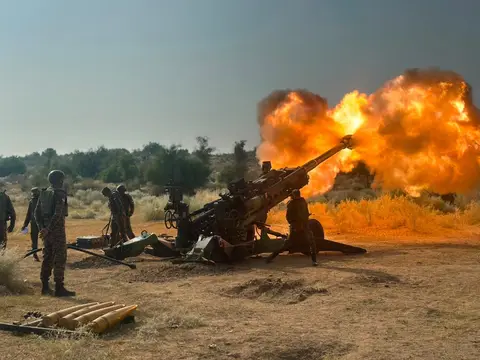
Sharang is the designation given to an upgraded 155mm artillery gun created by converting the Indian Army's older 130mm M-46 field guns of Russian origin into the modern 155mm calibre. Rather than acquiring entirely new weapons, this programme takes a large existing inventory of proven guns and upgrades them, extending both their range and their service life while standardising them on the calibre that now defines the Army's artillery systems. It is a cost-effective route to modernisation that makes use of assets the Indian Army already operates.
The 130mm M-46 was a widely used towed field gun known for its long range in its class, and India operated a substantial number of them for decades. As the Army moved towards standardising on 155mm ammunition across its force, converting these guns rather than retiring them offered a practical way to retain firepower while improving commonality of ammunition and logistics. The M-46's robust carriage made it a suitable candidate for such an upgrade, and reusing it avoided the expense and delay of designing an entirely new gun and mounting.
The upgrade concept
The core of the Sharang programme is reboring and re-ordnancing the 130mm gun to accept a 155mm barrel and associated components. This transforms the weapon from the older Russian calibre into a 155mm gun compatible with modern ammunition, giving it greater range and access to the wider variety of 155mm projectiles, including specialised and precision types. The work was carried out through the country's ordnance manufacturing establishment, part of the broader defence manufacturing base, and it drew on domestic engineering rather than external suppliers.
By reusing the existing carriage and much of the gun's structure while replacing the barrel and calibre-specific elements, the upgrade delivers a meaningful capability increase at a fraction of the cost of a new gun. Precise performance figures depend on the ammunition and charge used, but the conversion to 155mm inherently extends reach and brings the gun into line with the Army's standard calibre. The approach also reduces the training and logistics burden, because gunners increasingly work with a single family of ammunition rather than a patchwork of calibres inherited from different suppliers and eras.
Role within the fleet
Sharang occupies a distinct and pragmatic role within the Regiment of Artillery. It bridges the gap between legacy equipment and fully modern guns, allowing older platforms to remain relevant while new systems such as the DRDO-developed ATAGS are inducted in parallel. This layered approach lets the Army raise the overall standard of its artillery without the cost and lead time of replacing every gun outright, spreading modernisation across a larger portion of the fleet and keeping serviceable equipment in useful service.
Because Sharang uses the 155mm calibre, it also benefits from the same ammunition ecosystem as the rest of the modern fleet, including ongoing work on guided and extended-range rounds. Standardisation on a single calibre simplifies supply, training and maintenance across a force that historically operated a mix of calibres, easing the burden on the logistics chain and reducing the number of distinct natures of ammunition that must be stockpiled. The Sharang programme reflects a broader theme in India's artillery modernisation: extracting maximum value from existing assets through indigenous upgrade rather than relying solely on new procurement. Alongside high-profile new systems, upgrade programmes like this quietly strengthen the artillery arm by converting a large stock of serviceable guns into modern 155mm weapons, contributing to the twin goals of raising capability and reducing dependence on imports while newer designs are produced and inducted over time. Programmes of this kind rarely attract the attention given to entirely new guns, yet their cumulative effect on the readiness of the artillery arm is substantial, because they touch a large number of guns already dispersed among field units.