
 DEFENCE INDUSTRYTata Zorawar light tank clears Army's L1 hurdle for Rs 20,000 crore contract
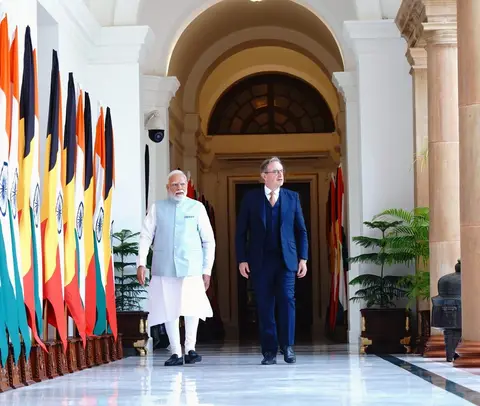 DEFENCE INDUSTRYIndia Belgium Defence Deals Sealed As PM De Wever Visits Delhi
 DEFENCE INDUSTRYAero India 2027 Dates Confirmed for February 8 to 12 in Bengaluru
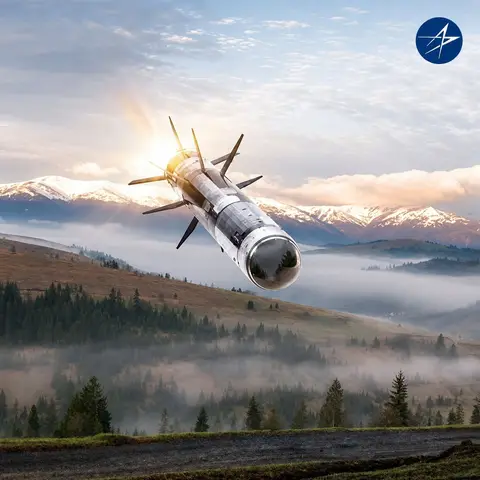 DEFENCE INDUSTRYJavelin missile co-production advances as Tata Advanced Systems signs Javelin Joint Venture pact
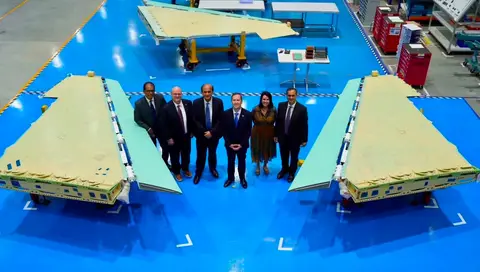 DEFENCE INDUSTRYTata Lockheed Martin MTA push gets a lift from US envoy's Hyderabad visit
The K9 Vajra-T is a 155mm/52-calibre tracked self-propelled howitzer manufactured in India by Larsen & Toubro under a technology-transfer agreement with South Korea's Hanwha, based on the widely exported K9 Thunder design. Ordered by the Indian Army to give mechanised strike formations organic, mobile heavy artillery support, the Vajra-T was selected after trials against competing tracked self-propelled gun designs and was among the earliest large deals concluded under the government's Buy and Make (Indian) route. Its induction marked one of the largest artillery contracts placed by India in decades and replaced the need for ageing self-propelled and towed guns to keep pace with tanks in the mechanised strike corps.
Key facts
- Type: Tracked self-propelled howitzer
- Origin: Based on South Korea's K9 Thunder; licence-manufactured in India
- Manufacturer: Larsen & Toubro, in partnership with Hanwha (formerly Hanwha Techwin/Hanwha Defense)
- Calibre: 155mm/52-calibre main gun
- Range: Approximately 18-40+ km depending on ammunition type, extending further with special projectiles
- Crew: Five (driver, commander, gunner and loaders)
- Status: In service with the Indian Army since 2018; further units on order
Development
The Indian Army's requirement for a tracked self-propelled gun to support offensive operations by its mechanised strike corps was finalised after prolonged trials of competing designs. In 2017, the government approved procurement of 100 K9-based howitzers under a contract with Larsen & Toubro as prime integrator, working with Hanwha for technology transfer. L&T set up production and integration facilities at Hazira in Gujarat, indigenising the fire-control system, direct-fire sighting and ammunition-handling systems while the hull and automotive layout follow the proven K9 Thunder design already in service with several other armies. All 100 guns under the initial contract were delivered by early 2021, ahead of the original schedule, and the type was formally inducted into Army regiments soon after. Building on this experience, Hanwha Aerospace and L&T confirmed a second order for around 100 additional K9 Vajra-T howitzers, underscoring the Army's intent to expand the fleet further.
Capabilities
The K9 Vajra-T combines a long-barrelled 155mm/52-calibre gun with an automated ammunition-handling system, allowing a high rate of fire and rapid response to fire missions without extended set-up time, an advantage over towed guns, which must be manually unlimbered and laid before firing, in mobile desert warfare. Its tracked chassis, powered by a diesel engine of roughly 1,000 horsepower, gives it cross-country mobility to keep pace with tanks and infantry combat vehicles, while composite armour protects the crew against small-arms fire and shell splinters. The howitzer is compatible with standard and extended-range ammunition natures, giving commanders flexibility in range and effect. On road, the vehicle can reach speeds of around 67 km/h with a cruising range of roughly 360 km, and its turret and hull provide protection against small-arms fire, artillery splinters and battlefield contamination, allowing the crew to operate closed-down under threat.
Service
The K9 Vajra-T equips artillery regiments supporting the Indian Army's mechanised strike formations, principally in the desert and semi-desert terrain of the western sector, where its speed and firepower complement armoured thrusts. Following the successful induction of the initial order, the Army and Ministry of Defence have moved forward with additional procurement to expand the fleet, reflecting confidence in the platform's performance and in the Make in India production model established for it. The type has also undergone cold-weather and high-altitude evaluation, reflecting Army interest in extending self-propelled firepower beyond its original desert-sector role, in addition to its established deployment supporting mechanised strike formations along the western border. The programme is frequently cited as a template for further self-propelled and towed gun projects pursued through indigenous manufacture with foreign technology partnership, and its steady, on-schedule delivery record has been contrasted favourably with the slower induction of some indigenously designed platforms.