
 INDIA DEFENCEDhruv NG Helicopter Explained: What HAL Has Actually Put Into Pawan Hans Service
 INDIA DEFENCELCA FOC Trainers Delivered With HTT 40 and Dhruv NG as Rajnath Singh Asks Engineers for Technologies That Do Not Exist
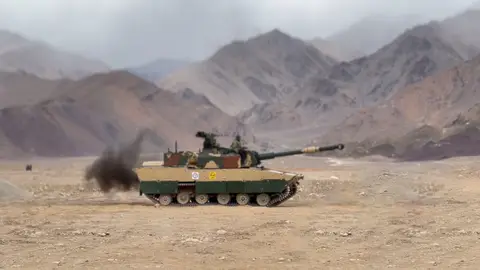 DEFENCE INDUSTRYTata Zorawar light tank clears Army's L1 hurdle for Rs 20,000 crore contract
 DEFENCE INDUSTRYIndia Belgium Defence Deals Sealed As PM De Wever Visits Delhi
 DEFENCE INDUSTRYAero India 2027 Dates Confirmed for February 8 to 12 in Bengaluru
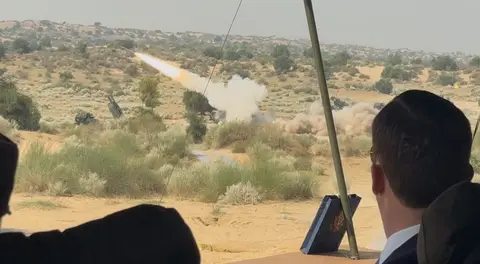
The Smerch is a long-range multi-barrel rocket launcher (MBRL) of Russian origin, operated by the Indian Army to provide heavy, deep-strike rocket-artillery firepower. Among the longest-ranged rocket systems in Indian service, the Smerch enables the Army to strike targets well beyond the reach of tube artillery, making it a key component of the deep-fires layer within the broader family of Indian artillery systems.
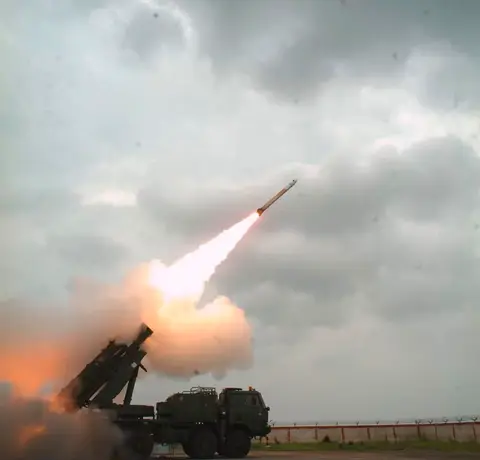
India acquired the Smerch to give its formations a long-range area-saturation capability, complementing the indigenous Pinaka MBRL which operates at medium range. Where Pinaka provides responsive rocket fire in support of the close and medium battle, the Smerch reaches deeper, allowing commanders to engage high-value targets, assembly areas and infrastructure at considerable distance. This division of roles gives the artillery arm a graduated set of rocket options matched to range and target type, so that fire missions can be assigned to the most appropriate system.
System characteristics
The Smerch fires large-calibre rockets from a bank of tubes mounted on a high-mobility wheeled chassis. A single launcher can deliver a devastating salvo over a wide area in a short time, and the system is supported by dedicated reloading and command vehicles. The rockets are considerably larger than those of medium-range systems, reflecting the trade-off inherent in rocket artillery: greater range and payload at the cost of a larger, heavier and more logistically demanding platform that consumes substantial resources to keep supplied.
The system's long reach and heavy salvo make it well suited to shaping operations, in which artillery strikes deep to disrupt an adversary before and during the main battle. As with all rocket artillery, the Smerch relies on mobility and rapid displacement after firing to survive counter-battery fire, and it is integrated with target-acquisition and command systems to make effective use of its range. Accurate deep fires depend as much on finding and tracking distant targets as on the launcher itself, so surveillance assets such as radars and unmanned aircraft are an essential part of employing the system effectively.
Role and integration
Within the Regiment of Artillery, the Smerch anchors the long-range rocket component, sitting above the medium-range Pinaka and the tube artillery of the Army's 155mm guns. This layered structure gives the Army options across the full depth of the battlefield, from close support delivered by guns to deep strikes delivered by rockets. The combination of imported and indigenous systems provides both immediate capability and a path towards greater self-reliance over time.
As a Russian-origin system, the Smerch depends on an external supply chain for rockets and spares, a consideration that has reinforced India's parallel investment in indigenous alternatives and its wider defence manufacturing base. The development and extension of the domestic Pinaka family, including longer-range and guided variants, is intended over time to give the Army a home-grown long-range rocket capability alongside imported systems, reducing dependence while retaining the deep-fires option the Smerch currently provides and securing the supply of the consumable rockets on which such systems depend. The Smerch also fits within the broader trend towards precision and extended range in artillery, as rocket forces worldwide move towards guided rockets that combine long reach with accuracy. For now, the Smerch remains a powerful and distinctive element of the Army's firepower, providing the longest organic reach among its rocket-artillery systems and underpinning the deep-fires capability of the force. Its presence in the order of battle allows planners to hold distant targets at risk with a weapon that is proven and understood, while indigenous programmes work to match and eventually surpass that reach. The lessons drawn from operating a long-range rocket system of this scale also inform requirements for the home-grown launchers and rockets that will follow, from handling and storage of large rounds to the surveillance and command arrangements needed to use them well.