
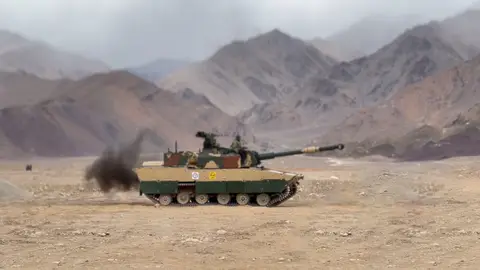
 DEFENCE INDUSTRYTata Zorawar light tank clears Army's L1 hurdle for Rs 20,000 crore contract
 DEFENCE INDUSTRYIndia Belgium Defence Deals Sealed As PM De Wever Visits Delhi
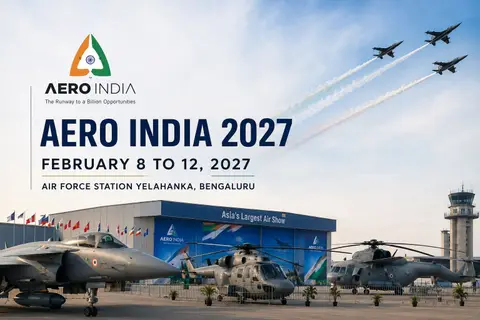 DEFENCE INDUSTRYAero India 2027 Dates Confirmed for February 8 to 12 in Bengaluru
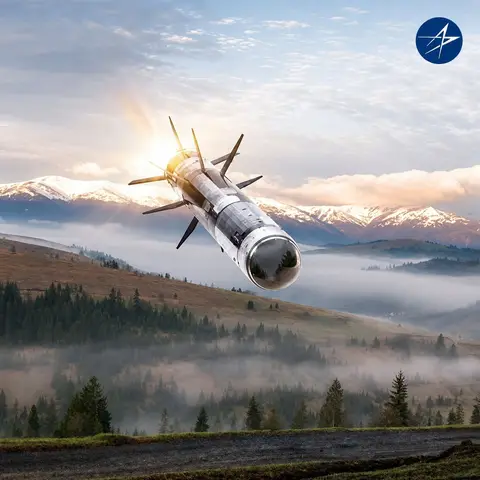 DEFENCE INDUSTRYJavelin missile co-production advances as Tata Advanced Systems signs Javelin Joint Venture pact
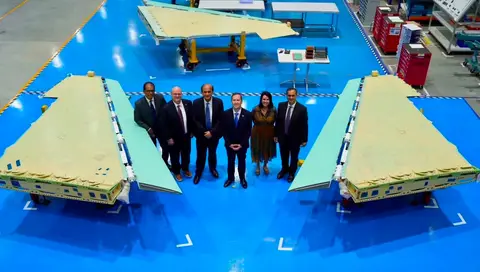 DEFENCE INDUSTRYTata Lockheed Martin MTA push gets a lift from US envoy's Hyderabad visit
The Sukhoi Su-30MKI is a twin-engine, twin-seat, long-range air-superiority fighter developed jointly by Russia's Sukhoi design bureau and India's Hindustan Aeronautics Limited (HAL). Featuring thrust-vectoring engines, canards and a heavy weapons load, it forms the backbone of the Indian Air Force's (IAF) fighter fleet and is the service's primary platform for the air-launched BrahMos-A cruise missile.
Key facts
- Role: Twin-engine, twin-seat air-superiority and multirole strike fighter
- Origin/Manufacturer: Sukhoi, Russia; licence-built by Hindustan Aeronautics Limited, India
- Engine: Two Lyulka-Saturn AL-31FP thrust-vectoring afterburning turbofans
- Top speed: Approximately Mach 2 (around 2,120 km/h)
- Combat radius: Around 1,500 km, extendable with aerial refuelling
- Armament: BrahMos-A supersonic cruise missile, R-73/R-77 air-to-air missiles, Astra missile, precision-guided bombs, a 30 mm cannon
- In service: Around 250 to 270 aircraft, the majority licence-built by HAL at Nashik
Licence Production in India
India contracted for 272 Su-30MKIs from Russia, of which around 50 were delivered as fly-away or knocked-down units and the remainder assembled and manufactured under licence by HAL at its Nashik division from 2000 onwards, with indigenous content rising over successive production batches. The programme gave HAL substantial experience in heavy-fighter manufacture, systems integration and depot-level overhaul, capabilities later applied to the Tejas and other indigenous programmes. India's original contract for the type dates to 1996, with the first Su-30MKIs entering IAF service in the early 2000s; successive follow-on orders through the 2000s and 2010s progressively expanded the fleet and increased the share of India-specific systems, including indigenous mission computers, electronic warfare equipment and the canard-and-thrust-vectoring configuration unique to the Indian variant.
BrahMos-A Strike Role
The Su-30MKI is the IAF's designated carrier for the air-launched BrahMos-A, a supersonic cruise missile developed jointly by India and Russia. HAL first test-flew a modified Su-30MKI carrying the missile in 2016, and the first successful air launch followed in November 2017. Roughly 40 aircraft have since been modified, with reinforced wings and undercarriage, to carry the roughly 2.5-tonne missile, forming two dedicated squadrons, with a further batch of about 20 aircraft under upgrade to create a third BrahMos-capable squadron.
Super Sukhoi Upgrade
HAL has undertaken a modernisation programme, informally termed the “Super Sukhoi” or Super-30 upgrade, covering 84 Su-30MKIs. The programme is intended to replace legacy Russian-origin avionics, radar and mission computers with indigenous systems, including the DRDO-developed Uttam active electronically scanned array (AESA) radar, and to integrate a wider weapons suite comprising the Astra beyond-visual-range missile, Rudram anti-radiation missiles and extended-range BrahMos-ER, alongside new self-protection and electronic warfare systems.
Capabilities
The Su-30MKI's canard-delta configuration and thrust-vectoring nozzles give it exceptional agility and high angle-of-attack performance, while a substantial internal fuel load and aerial-refuelling probe provide significant unrefuelled range and persistence. Its twin-seat cockpit divides tasks between pilot and weapon-systems operator, supporting complex multirole missions spanning air dominance, maritime strike and long-range interdiction across the subcontinent. The type also participates regularly in bilateral and multinational air exercises, reflecting the IAF's confidence in its versatility.
Operational Squadrons
Su-30MKIs equip numerous IAF squadrons across the country, including No. 24 “Hawks”, No. 20 “Lightnings”, No. 30 “Rhinos”, No. 8 “Pursoots”, No. 31 “Lions”, No. 221 “Desert Tigers”, No. 102 “Trisonics” and No. 106 “Lynx”, based at stations spanning the western and northern sectors to the eastern seaboard, reflecting the type's role as the IAF's principal multi-front heavy fighter.
Despite its Russian origins, sustained licence manufacture, indigenous weapons integration and the ongoing upgrade programme have made the Su-30MKI one of the most Indianised fighters in the IAF inventory, expected to remain a frontline type well into the 2030s.