
 DEFENCE INDUSTRYBrahMos export orders: Vietnam deal worth about $100 million, Indonesia $200 million as Akash reaches Tajikistan, Turkmenistan
 DEFENCE INDUSTRYMahindra Embraer Nagpur facility to assemble C-390 if IAF picks the aircraft
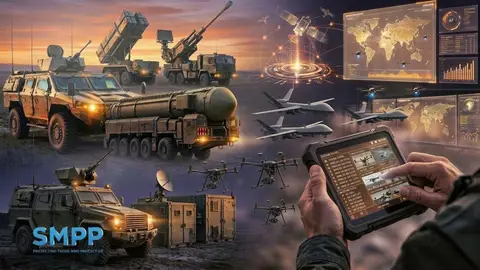 DEFENCE INDUSTRYSMPP Drone Manufacturing Push: Firm Shifts From Ammunition to Unmanned Warfare, Targets Integrated Defence Capabilities
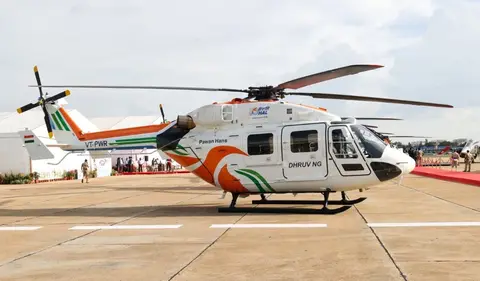 INDIA DEFENCEDhruv NG Helicopter Explained: What HAL Has Actually Put Into Pawan Hans Service
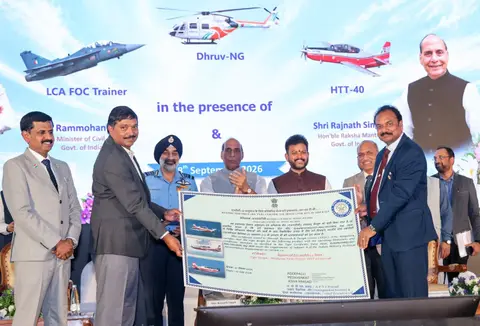 INDIA DEFENCELCA FOC Trainers Delivered With HTT 40 and Dhruv NG as Rajnath Singh Asks Engineers for Technologies That Do Not Exist
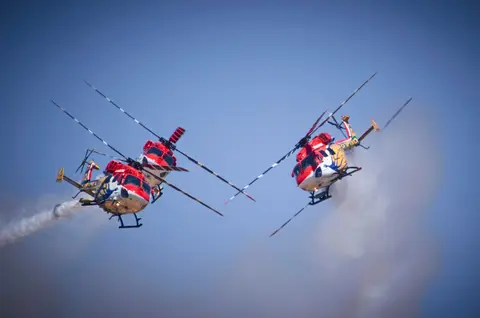
The HAL Dhruv is India's indigenous Advanced Light Helicopter (ALH), a twin-engine multirole rotorcraft developed by HAL. Its weaponised derivative, the Rudra, adds armament to create an armed variant for battlefield support. Together they are among the most widely used indigenous rotary-wing platforms and feature within the wider family of Military Aircraft of India, serving across all three armed services.
The Dhruv was developed to provide a versatile helicopter capable of a broad range of tasks, and it serves across India's armed forces in roles that include utility transport, casualty evacuation, reconnaissance, search and rescue and liaison. Its twin-engine layout and modern design give it good performance across varied terrain, including high-altitude operations, which are particularly demanding for helicopters because thin air reduces lift and engine power. The ability to operate reliably in such conditions is especially valuable given India's mountainous northern frontiers.
The Rudra armed variant
The Rudra is the weaponised version of the Dhruv, equipped to carry weapons and mission sensors so that it can provide armed support and close reconnaissance. Reported fits include a sensor and targeting turret and a mix of weapons, giving ground forces an organic armed rotary asset that can be tasked quickly in support of troops. The Rudra complements dedicated attack helicopters by offering a flexible, armed platform derived from a proven and widely supported airframe, which simplifies training and maintenance.
The armed and utility ALH variants are used across services, contributing to both mobility and firepower on the modern battlefield. They operate alongside India's dedicated attack helicopter, the Prachand Light Combat Helicopter, which shares design lineage and technologies developed through the ALH programme. This commonality across the indigenous helicopter family helps streamline logistics and pilot conversion.
The Rudra gives frontline units a responsive, organic capability that does not depend on calling in scarce dedicated attack helicopters for every task. Its sensors allow crews to observe and identify targets before engaging, while its weapons provide options ranging from suppressive fire to precision strikes. Because it is based on a helicopter already in wide service, units can adopt it with a shorter learning curve and shared maintenance practices, an advantage that matters when helicopters must be kept ready across widely dispersed and often remote bases.
Indigenous significance
As a home-grown helicopter family, the Dhruv and Rudra represent an important indigenous capability, reducing dependence on imported rotorcraft for many roles and building domestic expertise in helicopter design, manufacture and support. Their avionics and mission systems draw on Indian industry, and the platforms have been exported and demonstrated internationally, reflecting a degree of maturity and confidence in the design. Sensors and electronics for such platforms often involve firms such as BEL, deepening the domestic supply chain and spreading capability across the wider industrial base.
- Dhruv: twin-engine multirole Advanced Light Helicopter
- Rudra: weaponised armed variant
- Manufacturer: HAL
- Roles: utility, transport, reconnaissance, armed support
The ALH family has become a mainstay of Indian military aviation, valued for its adaptability and indigenous content. It demonstrates how a single well-designed airframe can be evolved into multiple variants serving different needs, from unarmed utility work to armed battlefield support, spreading development costs and simplifying support. The programme has also helped establish the design skills, tooling and supplier networks needed for more advanced rotorcraft. As India continues to expand its rotary-wing fleet with indigenous designs, the Dhruv and Rudra provide both operational capability today and a technological foundation for future helicopter programmes, underlining their central place in India's drive for self-reliance in defence. Their continued production and steady upgrades are expected to keep the family relevant for many years, supporting a wide range of missions across the services.