
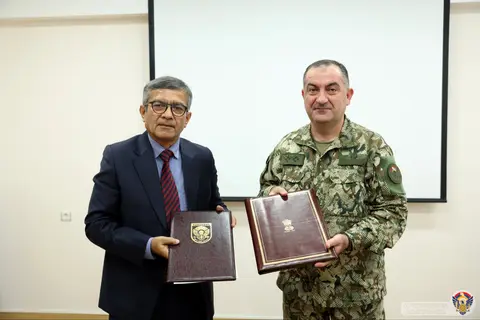
 DEFENCE INDUSTRYBrahMos export orders: Vietnam deal worth about $100 million, Indonesia $200 million as Akash reaches Tajikistan, Turkmenistan
 DEFENCE INDUSTRYMahindra Embraer Nagpur facility to assemble C-390 if IAF picks the aircraft
 DEFENCE INDUSTRYSMPP Drone Manufacturing Push: Firm Shifts From Ammunition to Unmanned Warfare, Targets Integrated Defence Capabilities
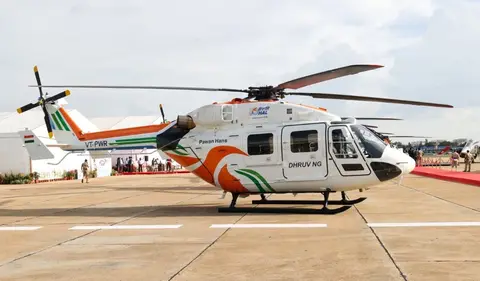 INDIA DEFENCEDhruv NG Helicopter Explained: What HAL Has Actually Put Into Pawan Hans Service
 INDIA DEFENCELCA FOC Trainers Delivered With HTT 40 and Dhruv NG as Rajnath Singh Asks Engineers for Technologies That Do Not Exist
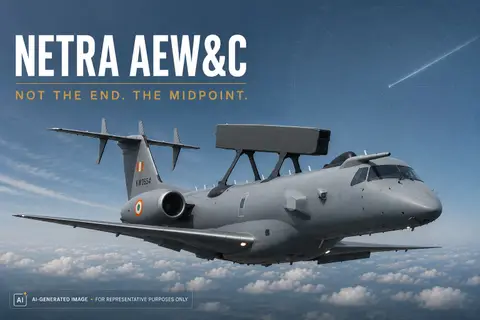
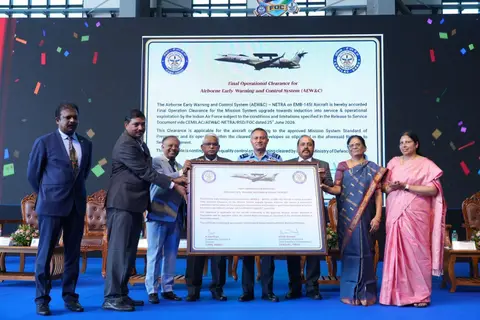
The DRDO Netra is an indigenous airborne early warning and control (AEW&C) aircraft that provides the Indian Air Force with aerial surveillance, early warning and airborne battle management. Developed by DRDO, it represents an important indigenous capability in a technologically demanding field and is a distinctive member of the fleet described in Military Aircraft of India.
Airborne early warning aircraft act as flying radar stations, extending the range at which air and surface activity can be detected far beyond the reach of ground-based radars. By operating at altitude, they can look over the horizon, track large numbers of targets at once and coordinate friendly aircraft, acting as force multipliers that greatly enhance situational awareness across a wide area. In modern air operations, the side with better awareness and coordination often holds a decisive advantage.
System and radar
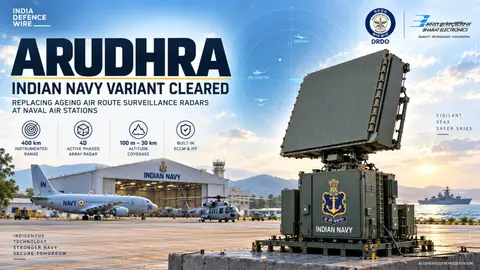
The Netra is built around an indigenous radar carried on a business-jet-class aircraft, giving it a surveillance capability over a wide arc. Its mission system integrates radar data with communications and identification systems, allowing controllers aboard the aircraft to build an air picture and direct friendly assets in real time. The development of such an active electronically scanned radar and its integration into an airborne platform is a significant technological achievement, drawing on Indian expertise in radar, signal processing and systems engineering. Industry partners such as BEL contribute to the wider ecosystem described in Military Radar Systems.
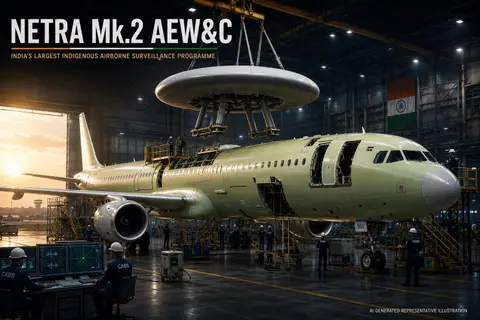
The Netra complements larger AEW&C platforms and is part of a broader effort to expand India's airborne surveillance fleet. The indigenous experience gained through the programme feeds into more ambitious future systems, including larger platforms based on transport-class aircraft that can carry more powerful radars and stay aloft longer. This step-by-step growth in capability mirrors the approach taken in other indigenous programmes.
An AEW&C aircraft is far more than its radar; it depends on reliable communications, secure data links and the ability to share a common picture with fighters, ground stations and command centres. Developing these networking and battle-management functions indigenously gives India control over how its air-defence system is knit together and how it evolves. The Netra also serves as a valuable testbed and training platform, allowing crews and engineers to build experience in airborne surveillance that will carry over to larger and more capable systems in the future.
Role and significance
For an air force, early warning and control aircraft are among the most valuable assets, since awareness and coordination often decide the outcome of air operations. The Netra enhances the IAF's ability to detect incoming threats early, manage its own aircraft efficiently and maintain a coherent air picture over contested areas. It works in concert with fighters and ground-based radars to create a layered air-defence network, passing early warning and direction to interceptors and surface systems alike.
- Role: airborne early warning and control
- Developer: DRDO
- Key system: indigenous airborne radar
- Status: in service
The Netra demonstrates India's growing ability to develop complex sensor and mission systems indigenously, reducing dependence on imported early-warning platforms and giving the country control over upgrades and sustainment. As threats become faster, more numerous and harder to detect, the value of airborne surveillance continues to grow. Building on the experience of the Netra, India is expected to field additional and larger AEW&C aircraft, steadily strengthening the airborne surveillance and battle-management capability that underpins modern air power and forms a vital part of the country's layered air-defence architecture. The knowledge gained in radar, systems integration and mission software through the Netra will continue to pay dividends across future Indian sensor and surveillance programmes, both airborne and ground-based.