
 DEFENCE INDUSTRYBrahMos export orders: Vietnam deal worth about $100 million, Indonesia $200 million as Akash reaches Tajikistan, Turkmenistan
 DEFENCE INDUSTRYMahindra Embraer Nagpur facility to assemble C-390 if IAF picks the aircraft
 DEFENCE INDUSTRYSMPP Drone Manufacturing Push: Firm Shifts From Ammunition to Unmanned Warfare, Targets Integrated Defence Capabilities
 INDIA DEFENCEDhruv NG Helicopter Explained: What HAL Has Actually Put Into Pawan Hans Service
 INDIA DEFENCELCA FOC Trainers Delivered With HTT 40 and Dhruv NG as Rajnath Singh Asks Engineers for Technologies That Do Not Exist
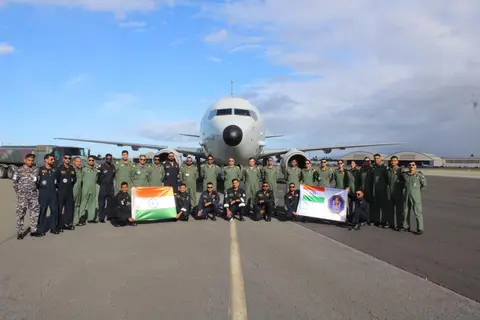
The P-8I Poseidon is a long-range maritime patrol and anti-submarine warfare aircraft operated by the Indian Navy. Based on a commercial airliner airframe adapted for military missions, it gives the Navy the ability to conduct wide-area surveillance, submarine hunting and maritime strike over vast expanses of ocean. It is among the most capable fixed-wing platforms in the fleet described in Military Aircraft of India.
Maritime patrol aircraft play a central role in securing sea lines of communication and monitoring activity across large maritime zones. The P-8I combines long endurance and range with a comprehensive sensor suite, allowing it to detect, track and, if required, engage surface and subsurface threats far from shore. Its jet performance lets it reach distant patrol areas quickly, while its endurance allows it to remain on station for extended periods, an important advantage over the vast Indian Ocean region.
Sensors and weapons
The aircraft carries a mission system built around radar, electro-optical sensors, acoustic processing and sonobuoys for detecting submarines. Sonobuoys are dropped into the water to listen for submarines, and their signals are analysed on board to build an underwater picture. It can deploy weapons associated with anti-submarine and anti-surface warfare, giving it a genuine engagement capability in addition to its surveillance function. Its reach and persistence make it a valuable intelligence, surveillance and reconnaissance asset for the fleet, complementing satellites, ships and shore stations.
Operating alongside carrier-based fighters such as the MiG-29K, the P-8I contributes to a layered picture of the maritime environment. Its wide-area coverage complements shorter-range shipborne sensors, and it works in concert with naval surface and subsurface assets to build maritime domain awareness across a wide area. This networking of sensors is central to modern naval operations.
Operating a large, complex aircraft like the P-8I also demands substantial support on the ground, including trained crews, maintenance facilities and mission-planning teams. Building this ecosystem has strengthened the Navy's overall maritime aviation expertise and created a foundation that benefits other programmes. The aircraft's open, upgradeable design allows new sensors, software and weapons to be added over time, helping it keep pace with evolving threats. In this way the P-8I is not a fixed capability but one expected to grow through the fleet's service life.
Strategic role
For a nation with an extensive coastline and significant maritime interests, long-range patrol aircraft are strategically important. The P-8I enhances India's ability to monitor its exclusive economic zone and the wider Indian Ocean region, supporting both peacetime surveillance and wartime operations. Growing undersea and surface activity in the region has increased the value of such persistent, long-range surveillance. It has also been employed in humanitarian and search-and-rescue tasks, underlining the versatility of large maritime aircraft in roles beyond direct combat.
- Role: long-range maritime patrol and anti-submarine warfare
- Operator: Indian Navy
- Key systems: radar, acoustic sensors, sonobuoys, ASW weapons
- Status: in service
The P-8I represents a significant enhancement of India's maritime patrol capability, extending the reach of naval surveillance far beyond coastal waters and giving commanders a clearer picture of activity at sea. As maritime competition and undersea activity increase across the region, such aircraft are central to maintaining awareness and deterrence. Complemented by unmanned systems and other sensors, and integrated with the wider fleet, the Poseidon force is expected to remain a cornerstone of India's maritime reconnaissance and anti-submarine capability, working within a broader network of naval air, surface and subsurface platforms to secure the country's maritime interests. Its long range and endurance mean that a relatively small number of aircraft can cover a very large area, making the fleet a highly efficient element of India's maritime surveillance effort.