
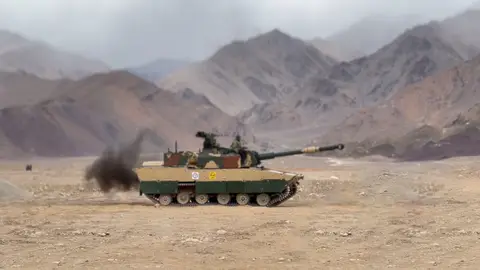
 DEFENCE INDUSTRYTata Zorawar light tank clears Army's L1 hurdle for Rs 20,000 crore contract
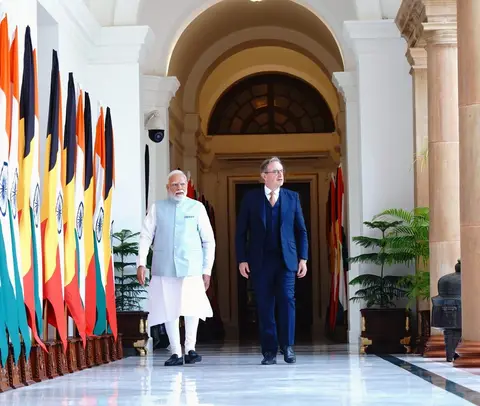 DEFENCE INDUSTRYIndia Belgium Defence Deals Sealed As PM De Wever Visits Delhi
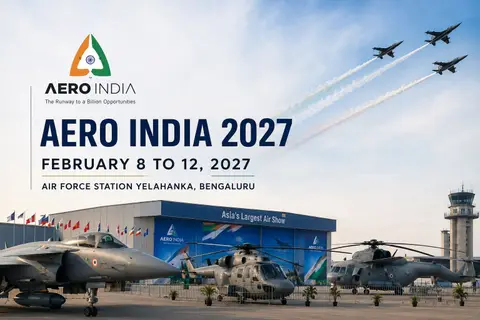 DEFENCE INDUSTRYAero India 2027 Dates Confirmed for February 8 to 12 in Bengaluru
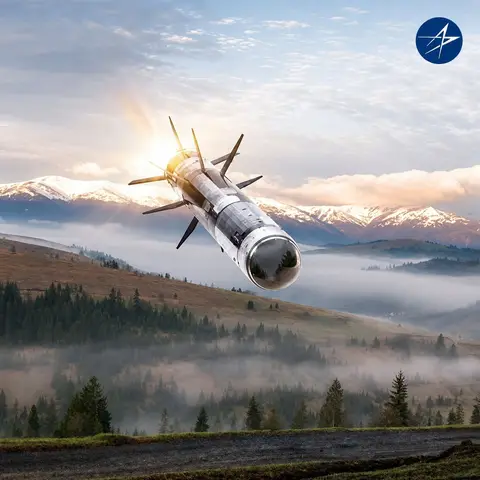 DEFENCE INDUSTRYJavelin missile co-production advances as Tata Advanced Systems signs Javelin Joint Venture pact
 DEFENCE INDUSTRYTata Lockheed Martin MTA push gets a lift from US envoy's Hyderabad visit
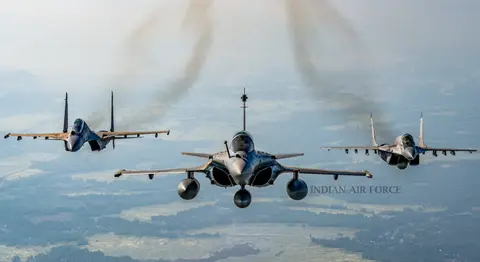
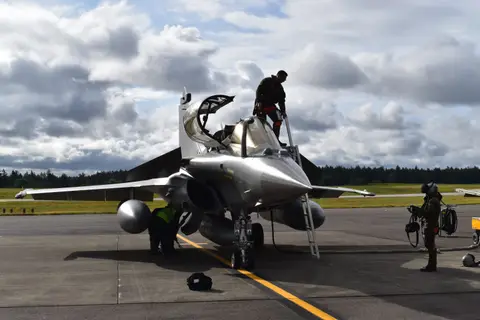
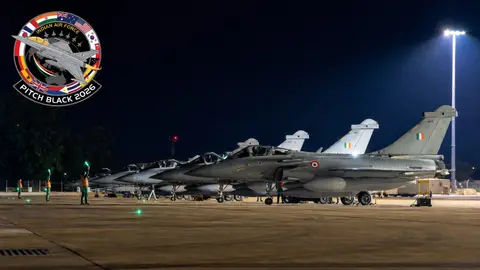
The Dassault Rafale is a twin-engine, delta-wing, multirole fighter aircraft manufactured by Dassault Aviation of France. India signed a government-to-government agreement in September 2016 for 36 Rafales in flyaway condition, tailored to Indian Air Force (IAF) specifications under an India-specific enhancements package, with deliveries running from mid-2020 to late 2022.
Key facts
- Role: Twin-engine multirole fighter for air superiority, deep strike, reconnaissance and nuclear delivery
- Origin/Manufacturer: Dassault Aviation, France
- Engine: Two Snecma (Safran) M88-2 afterburning turbofans
- Top speed: Mach 1.8 (approximately 1,900 km/h)
- Combat radius: Over 1,000 km, extendable with aerial refuelling and external tanks
- Armament: Meteor beyond-visual-range air-to-air missile, MICA air-to-air missile, SCALP cruise missile, HAMMER precision-guided munition, laser-guided bombs
- In service: 36 Rafale with the IAF; 26 Rafale-M on order for the Indian Navy
Induction and Squadrons
The IAF's Rafales are operated by two squadrons: No. 17 Squadron, the “Golden Arrows”, based at Ambala Air Force Station in the north, and No. 101 Squadron, the “Falcons of Chamb and Gwalior”, based at Hasimara Air Force Station in the east. This dual basing gives the IAF a rapid-response capability on both its western and eastern fronts. The type was selected after an extensive evaluation under the Medium Multi-Role Combat Aircraft (MMRCA) competition, which was eventually scaled back to a direct government-to-government order for 36 jets. The IAF formally inducted the Rafale on 10 September 2020 at Ambala Air Force Station, in a ceremony marking the type's operational debut after decades without a major new fighter acquisition.
Weapons and Sensors
The Rafale's principal advantage lies in its sensor fusion and weapons package. The Thales RBE2 active electronically scanned array (AESA) radar, the SPECTRA electronic warfare suite, and the OSF infrared search-and-track system give the aircraft strong situational awareness and self-protection. Its long-range Meteor missile, with a no-escape zone significantly larger than earlier-generation weapons, gives the IAF a marked beyond-visual-range advantage. The SCALP cruise missile and HAMMER precision-guided bomb add deep-strike and stand-off capability, both employed operationally by the IAF.
Rafale-M for the Indian Navy
In April 2025, India signed a contract for 26 Rafale-Marine (Rafale-M) aircraft, comprising 22 single-seat and four twin-seat variants, for carrier operations from INS Vikrant and INS Vikramaditya, replacing the Navy's ageing MiG-29K fleet. The Rafale-M shares substantial commonality with the IAF variant but includes a strengthened undercarriage, an arrester hook and folding wingtips for carrier operations. First deliveries are expected around 2029, intended to give Indian carrier aviation a modern, sensor-fused strike fighter.
Wider Fleet Expansion
In February 2026, India's Defence Acquisition Council granted Acceptance of Necessity for a follow-on acquisition of 114 fighters for the IAF, under which 18 aircraft would be delivered in flyaway condition and the remaining 96 manufactured in India with indigenous content of more than 25 percent. While the wider competition remains open, the Rafale's established infrastructure, shared logistics and integration with existing weapons stocks position it as a strong contender for the expanded requirement. Any such order would build further on the maintenance, training and spares infrastructure already established for the fleet since 2020, including simulators and a trained cadre of pilots and technicians at Ambala and Hasimara.
Since induction, the Rafale has featured prominently in high-visibility exercises and operational deployments, cementing its status as one of the IAF's most capable frontline fighters and a key pillar of India's air-power modernisation.