
 INDIA DEFENCEDhruv NG Helicopter Explained: What HAL Has Actually Put Into Pawan Hans Service
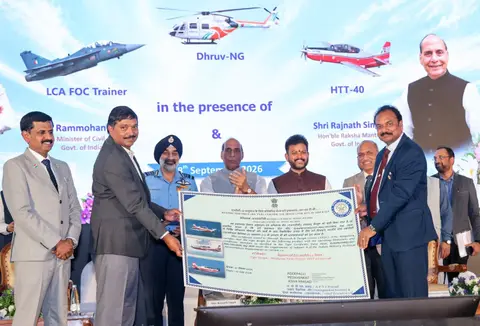 INDIA DEFENCELCA FOC Trainers Delivered With HTT 40 and Dhruv NG as Rajnath Singh Asks Engineers for Technologies That Do Not Exist
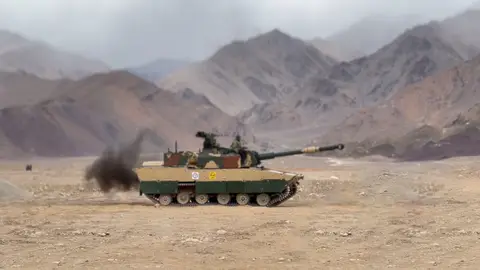 DEFENCE INDUSTRYTata Zorawar light tank clears Army's L1 hurdle for Rs 20,000 crore contract
 DEFENCE INDUSTRYIndia Belgium Defence Deals Sealed As PM De Wever Visits Delhi
 DEFENCE INDUSTRYAero India 2027 Dates Confirmed for February 8 to 12 in Bengaluru
The Defence Research and Development Organisation (DRDO) is India's premier agency for military research and development, functioning under the Department of Defence Research and Development within the Ministry of Defence. Established in 1958 through the merger of earlier defence technical establishments, its mandate is to design, develop and deliver indigenous weapon systems, platforms and technologies to the armed forces, and to reduce dependence on foreign suppliers. Over more than six decades it has grown into one of the largest research organisations in the country, employing scientists and engineers across a broad spectrum of disciplines.
Organisation and Leadership
DRDO is headed by a Chairman who also serves as Secretary of the Department of Defence Research and Development and as the Scientific Adviser to the Raksha Mantri, the Defence Minister. The organisation is administered through a headquarters at DRDO Bhavan in New Delhi and is organised into technology clusters and directorates that group laboratories by domain, such as aeronautics, missiles and strategic systems, naval systems, armaments, electronics, materials, and life sciences.
This cluster structure is designed to align individual laboratories around common technology areas and major programmes, allowing specialised institutions to collaborate on integrated platforms. Corporate directorates at headquarters handle planning, human resources, quality, and industry interface, while the technology clusters coordinate the scientific work. DRDO works closely with the defence public sector undertakings and private industry, which manufacture and productionise the systems it develops.
The Laboratory Network
DRDO operates a large network of specialised laboratories and establishments spread across the country. These institutions cover fields ranging from aeronautical design and combat aircraft development to guided missiles, radars, armoured vehicles, electronic warfare, high-energy materials, and food and medical sciences for troops operating in extreme environments. A fuller account is given on the DRDO laboratories network page.
Together these laboratories have contributed to a wide portfolio of Indian systems. DRDO's missile work underpins several of the systems described in the overview of missiles in India, including the surface-to-air Akash system and the Astra beyond-visual-range air-to-air missile. In aeronautics, DRDO's Aeronautical Development Agency led the design of the Tejas light combat aircraft, a programme continued in the Tejas Mk2, while its naval laboratories develop sonars and underwater systems for the fleet.
Flagship Programmes and Industry Partnership
Over the decades DRDO has run several flagship efforts, most notably the Integrated Guided Missile Development Programme, which laid the foundations for India's missile capabilities across surface-to-air, air-to-air and strategic categories. Its aeronautics work supports the wider ecosystem of Indian military aircraft, while its electronics and sensor research feeds systems produced by partners such as Bharat Electronics Limited.
A defining feature of DRDO's model is that it concentrates on design and development while transferring technology to production agencies. Guided missiles designed by its laboratories are manufactured by Bharat Dynamics Limited, aircraft by Hindustan Aeronautics Limited, and a range of electronic and armament systems by other public and private manufacturers. This division of labour connects DRDO tightly to the broader story of defence manufacturing in India.
- Research and design: laboratories develop prototypes and mature technologies to production readiness.
- Technology transfer: proven designs pass to DPSUs and private firms for series production.
- User trials: systems are validated with the Army, Navy and Air Force before induction.
DRDO also supports indigenous innovation more broadly, contributing expertise to newer initiatives that draw start-ups and academia into defence technology, and running extramural research schemes with universities. It maintains extensive testing infrastructure, including ranges and evaluation facilities shared with the services. As India pursues self-reliance in defence, the organisation remains central to translating research into fielded capability, working alongside the services, the DPSUs and a growing private sector to deliver systems that meet the operational needs of the armed forces.