
 INDIA DEFENCEDhruv NG Helicopter Explained: What HAL Has Actually Put Into Pawan Hans Service
 INDIA DEFENCELCA FOC Trainers Delivered With HTT 40 and Dhruv NG as Rajnath Singh Asks Engineers for Technologies That Do Not Exist
 DEFENCE INDUSTRYTata Zorawar light tank clears Army's L1 hurdle for Rs 20,000 crore contract
 DEFENCE INDUSTRYIndia Belgium Defence Deals Sealed As PM De Wever Visits Delhi
 DEFENCE INDUSTRYAero India 2027 Dates Confirmed for February 8 to 12 in Bengaluru
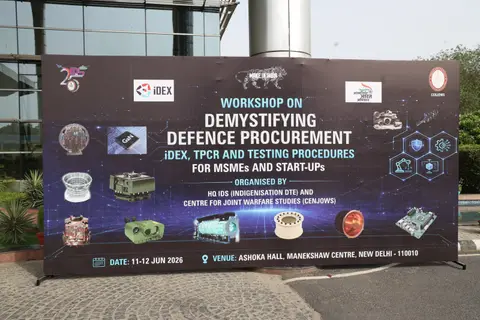
Innovations for Defence Excellence (iDEX) is a government initiative created to foster innovation and technology development in India's defence and aerospace sector by engaging start-ups, micro, small and medium enterprises (MSMEs), individual innovators, research and development institutes and academia. Launched to bring fresh ideas and agile players into a field long dominated by large public sector undertakings, iDEX has become a prominent vehicle for defence innovation and a visible symbol of the wider drive towards self-reliance.
Purpose and Structure
iDEX is operated under a dedicated body, the Defence Innovation Organisation, and functions with support from the Ministry of Defence. Its core purpose is to identify pressing capability needs of the armed forces and to fund innovators to develop solutions, providing grants and support to take promising ideas from concept to prototype and, where successful, towards induction into service.
The initiative is designed to complement, rather than replace, the established ecosystem of defence public sector undertakings and research agencies. By channelling problems from the services directly to a broad community of innovators, iDEX seeks to accelerate the pace of technology development and to widen participation in defence manufacturing in India, bringing in players who might otherwise struggle to enter the defence market.
How It Works
iDEX typically operates through structured challenges and funding rounds, in which the armed forces and other users articulate specific problem statements, and innovators compete to propose and develop solutions. The main elements include:
- Defence challenges: problem statements issued by the services and other organisations seeking novel technologies.
- Grant funding: financial support to selected start-ups and MSMEs to build and demonstrate prototypes.
- Handholding and mentorship: guidance, incubation support and access to testing facilities to help innovators mature their products.
- Pathways to procurement: mechanisms that can lead to trials and orders where solutions prove viable.
The technologies pursued through iDEX span areas such as unmanned systems, artificial intelligence, sensors, communications, cyber security and advanced materials. Successful innovations can feed into or complement the work of established players; for example, sensor and electronics ideas may relate to the domains served by Bharat Electronics Limited, while aerospace concepts connect to the ecosystem around Hindustan Aeronautics Limited. Research leadership from the DRDO also intersects with many of the technology areas iDEX addresses.
Significance and Impact
iDEX represents a shift in approach, treating start-ups and small firms as serious contributors to defence capability rather than peripheral suppliers. By offering funding, access and a route towards procurement, it lowers the barriers that have historically kept smaller innovators out of the defence market and helps convert promising research into deployable products.
The initiative aligns closely with national policy goals of self-reliance and indigenisation, working in parallel with other reforms across the sector. Its emphasis on speed and experimentation is intended to help India keep pace with rapidly evolving defence technologies, where agility and iteration matter as much as scale.
By nurturing a community of innovators and connecting them to the needs of the armed forces, iDEX aims to build a durable pipeline of home-grown defence technology. As the initiative matures and its winners move from prototypes towards production, it is increasingly seen as an important complement to the traditional pillars of India's defence industrial base and a catalyst for a broader culture of innovation. By demonstrating that small firms and individual innovators can deliver useful defence technologies, it encourages talent and investment to flow into the field, strengthening the wider ecosystem over time. Its continued success depends on sustaining funding, streamlining the path from prototype to order, and ensuring that promising solutions are absorbed into service. If those conditions are met, iDEX has the potential to reshape how India develops defence technology, complementing the deep expertise of its research agencies and public sector with the speed and creativity of a broad innovation community, and helping the country field advanced capabilities more quickly and at lower cost.