
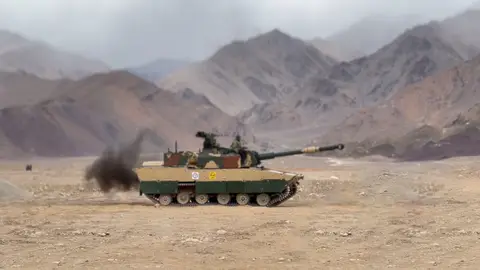
 DEFENCE INDUSTRYTata Zorawar light tank clears Army's L1 hurdle for Rs 20,000 crore contract
 DEFENCE INDUSTRYIndia Belgium Defence Deals Sealed As PM De Wever Visits Delhi
 DEFENCE INDUSTRYAero India 2027 Dates Confirmed for February 8 to 12 in Bengaluru
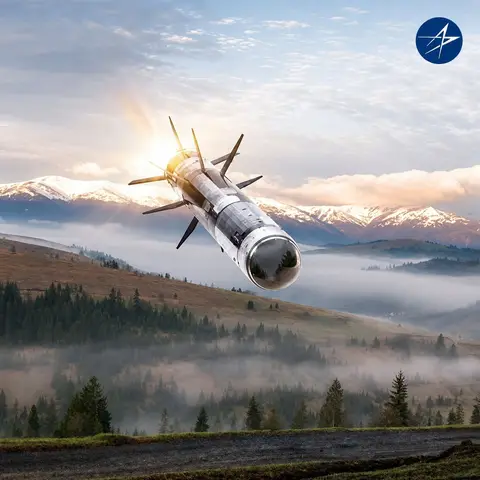 DEFENCE INDUSTRYJavelin missile co-production advances as Tata Advanced Systems signs Javelin Joint Venture pact
 DEFENCE INDUSTRYTata Lockheed Martin MTA push gets a lift from US envoy's Hyderabad visit
Arudhra is a medium-power radar (MPR) designed by DRDO and manufactured by Bharat Electronics Limited for the Indian Air Force's ground-based air-defence network. Built around a rotating active phased-array antenna, it is one of India's first indigenous four-dimensional radars, resolving a target's range, azimuth, height and Doppler velocity in a single scan, and represents a significant step up in range and power over the earlier Rohini radar, placing India among a small group of countries fielding an indigenous S-band four-dimensional ground radar of this scale.
Key facts
- Type: Medium Power Radar (MPR), a rotating active phased-array air-surveillance radar
- Developer: DRDO's Electronics and Radar Development Establishment (LRDE), manufactured by Bharat Electronics Limited
- Band: S-band (2-4 GHz)
- Range: maximum instrumented range of around 400 km; detects a 2 sqm radar-cross-section fighter-sized target out to about 300 km and a low-observable 0.2 sqm target out to roughly 160 km
- Scan: 360-degree azimuth coverage, rotating at 7.5 or 15 revolutions per minute, with elevation coverage of 30 degrees in surveillance mode and up to 50 degrees in tracking mode
- Role: long-range air surveillance and target acquisition, including tracking of rockets, artillery shells and mortar projectiles
Development
Arudhra was developed by LRDE as a higher-power successor to Rohini, using solid-state transmit/receive modules across an active phased-array face in place of Rohini's passive array, allowing greater transmitted power, finer resolution and longer detection range. The Ministry of Defence signed contracts worth around Rs 3,700 crore with BEL in March 2023 covering series production of Arudhra radars together with DR-118 radar warning receivers, formalising the radar's move from development into large-scale supply for the Indian Air Force. The radar underwent extensive user trials with the Indian Air Force before induction, and was shown publicly at defence exhibitions as DRDO and BEL demonstrated its transition from prototype to a production-ready system.
Capabilities
Because Arudhra resolves targets in four dimensions rather than three, it can generate a precise height and velocity profile for each contact alongside its range and bearing, improving discrimination between genuine threats and clutter or decoys. Its rotating active array switches between a wide-coverage surveillance mode, sweeping the full 360-degree horizon at low elevation, and a narrower, higher-elevation tracking mode that extends coverage to 50 degrees, useful for following steep-trajectory threats such as artillery shells and rockets. The radar is designed to keep operating in a jamming-heavy electronic warfare environment, incorporating counter-countermeasure features to maintain track continuity against active interference. Arudhra is intended to work alongside Rohini and other ground sensors as part of a networked, layered air-defence grid, cross-cueing shorter-range fire-control radars and missile batteries rather than operating as a stand-alone system.
Deployment
Arudhra radars are being progressively inducted into Indian Air Force ground-based air-defence units, feeding target data into the Integrated Air Command and Control System (IACCS) alongside Rohini and other surveillance sensors, and cueing surface-to-air missile batteries against aircraft, helicopters and stand-off weapons approaching Indian airspace. As deliveries under the 2023 production contracts continue, Arudhra is expected to progressively replace or supplement older-generation medium-power radars in IAF service, extending the reach and resolution of India's layered, networked air-defence radar cover.