
 DEFENCE INDUSTRYBrahMos export orders: Vietnam deal worth about $100 million, Indonesia $200 million as Akash reaches Tajikistan, Turkmenistan
 DEFENCE INDUSTRYMahindra Embraer Nagpur facility to assemble C-390 if IAF picks the aircraft
 DEFENCE INDUSTRYSMPP Drone Manufacturing Push: Firm Shifts From Ammunition to Unmanned Warfare, Targets Integrated Defence Capabilities
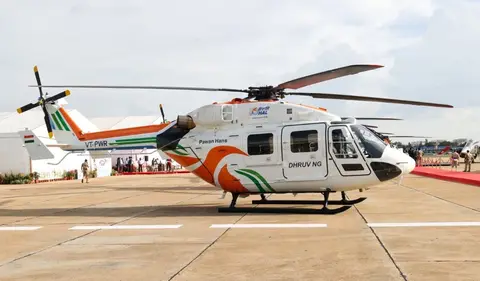 INDIA DEFENCEDhruv NG Helicopter Explained: What HAL Has Actually Put Into Pawan Hans Service
 INDIA DEFENCELCA FOC Trainers Delivered With HTT 40 and Dhruv NG as Rajnath Singh Asks Engineers for Technologies That Do Not Exist
Swordfish is a long-range tracking radar (LRTR) developed for India's ballistic-missile-defence (BMD) programme by the Defence Research and Development Organisation (DRDO). It provides the early detection and precise tracking of incoming ballistic missiles that a two-tier interceptor shield depends upon, and it is one of the most capable radars fielded within India's military radar systems. Without a radar able to see and follow a warhead travelling at extreme speed and altitude, the interceptors that make up a missile shield would have nothing to aim at.
The radar was developed with technology derived from the Israeli EL/M-2080 Green Pine, the radar associated with Israel's Arrow anti-ballistic-missile system, adapted and enhanced for Indian requirements. It is an active electronically scanned array (AESA) design, in which large numbers of transmit-receive elements work together to form and steer the beam electronically. This allows Swordfish to track very fast, high-altitude targets at long range while simultaneously handling the search and discrimination tasks needed for interception.
Role in ballistic-missile defence
India's BMD architecture is built around a two-layered set of interceptors intended to destroy hostile ballistic missiles at high and lower altitudes. Swordfish serves as the primary fire-control and tracking sensor for this shield. It detects a launch at long range, tracks the incoming warhead throughout its flight, attempts to discriminate the genuine warhead from decoys and debris, and cues the interceptor missiles onto the target. The accuracy of this tracking is critical, because interception requires the defending missile to be guided to a precise point in space with very little margin for error, sometimes described as hitting a bullet with a bullet.
Successive tests of India's interceptors have relied on Swordfish and its derivatives to demonstrate the ability to engage targets simulating incoming ballistic threats. In these trials the radar must acquire the target early, maintain a stable track and pass a continuously updated engagement solution to the interceptor's own guidance. Reports indicate the radar's range has been progressively extended in later versions to keep pace with longer-range and more capable threats, though precise figures published in open sources should be treated with caution.
Development and significance
Swordfish represents a considerable step up in complexity from earlier Indian surveillance radars, moving into the demanding domain of tracking objects travelling at ballistic-missile speeds. Meeting this challenge required advances in high-power transmission, large array design, fast signal processing and the software needed to sort real threats from clutter. The development strengthened India's expertise in these areas, expertise that also informs newer programmes.
- Type: long-range AESA tracking radar
- Primary role: detection and tracking for ballistic-missile defence
- Heritage: derived from the Israeli Green Pine design
- Developer: DRDO
The radar is a key enabler for the layered defence of high-value targets and population centres, and it does not operate in isolation. Its tracks feed into command-and-control networks that fuse sensor data into a single air picture, such as the Integrated Air Command and Control System, so that decisions to engage can be taken quickly and coherently. As India advances longer-range air- and missile-defence programmes, the tracking and discrimination capabilities pioneered on Swordfish feed directly into the next generation of interceptor radars being developed for systems such as the forthcoming Kusha long-range SAM. Operated in support of the Indian Air Force, Swordfish remains central to the country's strategic defensive posture and to its ambition of a credible, largely indigenous shield against missile attack. Because ballistic-missile defence must work reliably the very first time it is needed, the radar is subjected to demanding trials and continual refinement, and each successful interception test adds confidence that the sensor at the heart of the shield can perform its role when it matters most.