
 DEFENCE INDUSTRYBrahMos export orders: Vietnam deal worth about $100 million, Indonesia $200 million as Akash reaches Tajikistan, Turkmenistan
 DEFENCE INDUSTRYMahindra Embraer Nagpur facility to assemble C-390 if IAF picks the aircraft
 DEFENCE INDUSTRYSMPP Drone Manufacturing Push: Firm Shifts From Ammunition to Unmanned Warfare, Targets Integrated Defence Capabilities
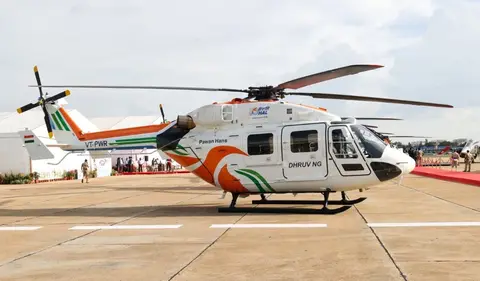 INDIA DEFENCEDhruv NG Helicopter Explained: What HAL Has Actually Put Into Pawan Hans Service
 INDIA DEFENCELCA FOC Trainers Delivered With HTT 40 and Dhruv NG as Rajnath Singh Asks Engineers for Technologies That Do Not Exist
The Integrated Air Command and Control System (IACCS) is an automated network operated by the Indian Air Force that gathers data from many radars and sensors and fuses it into a single, coherent picture of the airspace. Rather than viewing feeds from individual sensors in isolation, commanders using IACCS see one integrated, real-time recognised air picture on which to base decisions. This makes the system the nerve centre that ties together India's military radar systems and turns a scattered collection of sensors into a coherent air-defence enterprise.
IACCS links ground-based surveillance radars, low-level and mobile radars, airborne early-warning aircraft, civilian air-traffic inputs and other sources over secure communication networks. Software correlates these tracks, removes duplication where two sensors see the same aircraft, resolves conflicts and presents a unified display. Just as importantly, it enables the flow of orders and information in the other direction, connecting control centres, sensors and weapon systems so that a decision to act can be transmitted and executed quickly.
Why integration matters
Air defence is fundamentally a problem of time. Aircraft and missiles move fast, and the interval between detection and engagement is short, often measured in minutes or less. By automating the fusion of sensor data and the passing of orders, IACCS compresses this timeline, allowing threats to be identified, classified as friend or foe, and dealt with far more quickly than manual, voice-based methods would allow. It also reduces the risk of gaps, double-counting or confusion when many sensors are reporting at once during an intense engagement.
The system connects the sensors that detect threats with the weapons that counter them. Surface-to-air missile batteries such as Akash and QRSAM, and long-range systems like the S-400, can all be tied into the wider picture, allowing a threat to be assigned to the most appropriate weapon. This network-centric approach lets India operate a genuinely layered air defence in which detection, decision and engagement are tightly coordinated rather than handled by independent, disconnected units.
Development and expansion
IACCS was developed with a strong indigenous component, with Bharat Electronics Limited (BEL) a principal partner in building the system, drawing on design and technology work supported by DRDO laboratories. Building such a network requires not only powerful software but also resilient, secure communications and careful integration with a wide variety of sensors, many of which speak different technical languages and must be brought onto a common picture.
- Type: automated air command-and-control network
- Primary role: sensor fusion and coordinated air defence
- Operator: Indian Air Force
- Key partner: BEL
The network has been progressively expanded through multiple nodes across the country, steadily widening the area under integrated, automated control and improving the redundancy of the system so that the loss of any one node does not blind a region. By binding together surveillance radars, tracking radars and shooters into one system, IACCS gives real value to India's growing inventory of radars and missiles. It is the connective tissue that transforms individual pieces of equipment into an air-defence architecture, and its continued expansion is central to the country's ability to monitor and defend its airspace against increasingly complex and numerous aerial threats. Modern threats increasingly arrive not singly but in coordinated waves, mixing aircraft, cruise missiles and drones to overwhelm defenders, and only a networked, automated system can hope to sort such a picture in time. By providing that capability across the whole of India's airspace, IACCS underpins the effectiveness of every sensor and weapon plugged into it, and its steady growth reflects the recognition that in modern air defence, information and its rapid sharing are as decisive as the missiles themselves.