
 DEFENCE INDUSTRYBrahMos export orders: Vietnam deal worth about $100 million, Indonesia $200 million as Akash reaches Tajikistan, Turkmenistan
 DEFENCE INDUSTRYMahindra Embraer Nagpur facility to assemble C-390 if IAF picks the aircraft
 DEFENCE INDUSTRYSMPP Drone Manufacturing Push: Firm Shifts From Ammunition to Unmanned Warfare, Targets Integrated Defence Capabilities
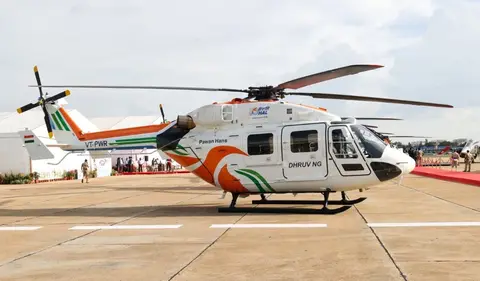 INDIA DEFENCEDhruv NG Helicopter Explained: What HAL Has Actually Put Into Pawan Hans Service
 INDIA DEFENCELCA FOC Trainers Delivered With HTT 40 and Dhruv NG as Rajnath Singh Asks Engineers for Technologies That Do Not Exist
Rajendra is a mobile phased-array fire-control radar developed in India as the sensor heart of the Akash surface-to-air missile system. Designed and developed by the Electronics and Radar Development Establishment (LRDE) under the Defence Research and Development Organisation (DRDO), the radar carries out multi-function tasks that would traditionally require several separate systems. This consolidation of surveillance, tracking and guidance into a single sensor makes it a cornerstone of India's indigenous air-defence effort and one of the earliest large phased-array radars to be fielded by the country.
The radar uses electronically steered phased-array technology, in which the beam is pointed rapidly by controlling the phase of signals across a fixed antenna face rather than by physically slewing a dish. This gives Rajendra the ability to interleave several tasks almost at once: searching a volume of airspace, tracking multiple targets and guiding missiles towards several of them. Mounted on a tracked or wheeled vehicle for battlefield mobility, it is intended to move with the forces it protects and to set up quickly when a defensive position is taken up.
Role within the Akash system
Within an Akash battery, Rajendra performs the fire-control function. It detects and tracks incoming aircraft, helicopters and other aerial threats, computes engagement solutions and steers the missiles in flight through command guidance, refining their trajectory as the target manoeuvres. A single radar can reportedly track a number of targets simultaneously and direct missiles against several of them, giving each battery a genuine multi-target engagement capability rather than the one-at-a-time limitation of older designs.
Longer-range early warning and surveillance in an Akash deployment are typically provided by companion radars that scan wide areas and hand off target data to Rajendra for the terminal engagement. This division of labour lets each sensor specialise: the surveillance radar builds the broad air picture, while Rajendra concentrates its performance on precisely tracking and guiding against the specific threats being engaged. The result is a layered arrangement in which detection, decision and interception are tightly linked.
Variants of the radar have been produced for both the Indian Army and the Indian Air Force, reflecting the two services' differing mobility, terrain and deployment needs. The Army version emphasises cross-country mobility to accompany manoeuvring formations, while the Air Force uses the system to protect fixed assets such as airbases. Production of the radar and associated electronics has drawn heavily on India's defence public-sector base, with Bharat Electronics Limited (BEL) a key manufacturing partner for the wider Akash programme.
Significance and evolution
Rajendra was among the first large phased-array radars to be designed and fielded in India, and the experience gained shaped subsequent DRDO radar work in important ways. Building the antenna, the beam-steering electronics and the signal processing required to track and guide against fast targets gave Indian engineers hard-won expertise in a technology that many nations guard closely.
- Type: mobile multi-function phased-array fire-control radar
- Primary role: target tracking and missile guidance for Akash
- Developer: LRDE, under DRDO
- Users: Indian Army and Indian Air Force
Lessons from Rajendra's development fed into later multi-function and active electronically scanned array (AESA) programmes, including efforts to build radars with active transmit-receive modules rather than the passive array used in the original design. As newer air-defence systems enter service, Rajendra remains a widely deployed example of an indigenous fire-control radar and a reference point for India's broader push towards self-reliance in sensors. It sits alongside other home-grown systems described in the overview of military radar systems in India, and complements the surveillance and command networks that feed the country's layered air-defence architecture. The continued upgrade of Akash, including improved-range and quick-reaction variants, has kept the radar and its successors central to protecting high-value assets and forward troop concentrations from aerial attack.