
 DEFENCE INDUSTRYTata Zorawar light tank clears Army's L1 hurdle for Rs 20,000 crore contract
 DEFENCE INDUSTRYIndia Belgium Defence Deals Sealed As PM De Wever Visits Delhi
 DEFENCE INDUSTRYAero India 2027 Dates Confirmed for February 8 to 12 in Bengaluru
 DEFENCE INDUSTRYJavelin missile co-production advances as Tata Advanced Systems signs Javelin Joint Venture pact
 DEFENCE INDUSTRYTata Lockheed Martin MTA push gets a lift from US envoy's Hyderabad visit
Rohini, formally the 3D Central Acquisition Radar (3D-CAR), is a ground-based, medium-range surveillance radar designed by DRDO's Electronics and Radar Development Establishment (LRDE) and manufactured by Bharat Electronics Limited (BEL). It was one of the first indigenous three-dimensional radars inducted into the Indian Air Force and now serves as the primary acquisition sensor for Akash surface-to-air missile squadrons, replacing older imported two-dimensional radars that could not measure target height with comparable precision.
Key facts
- Type: ground-based 3D medium-range surveillance and central acquisition radar
- Developer: DRDO's LRDE, manufactured by Bharat Electronics Limited, with contributions from Larsen & Toubro and Astra Microwave
- Band: S-band
- Detection range: over 170 km horizontally, with altitude coverage above 15 km
- Tracking capacity: up to about 150 targets simultaneously in scan mode, including targets flying at speeds up to roughly Mach 3
- Role: central acquisition and early-warning radar for Akash SAM squadrons and general IAF air-defence surveillance
Development
Rohini was developed as part of India's push to field an indigenous three-dimensional air-surveillance radar capable of replacing imported systems in the Indian Air Force's ground-based air-defence network. Its passive phased-array antenna, arranged in 32 rows of 48 radiating elements across four segments, generates seven stacked pencil beams that allow the radar to measure target height accurately alongside range and bearing, giving it a genuine three-dimensional picture rather than the two-dimensional plot produced by older search radars. Larsen & Toubro and Astra Microwave contributed sub-systems and components during development, reflecting the broader industry partnerships DRDO and BEL have built around major radar programmes.
Capabilities
Beyond its core surveillance role, Rohini incorporates electronic counter-countermeasure (ECCM) features, including frequency agility and jammer analysis, to keep functioning in an actively contested electromagnetic environment. It can detect and track both low-flying and high-speed targets, and its scan-mode capacity of roughly 150 tracks allows it to maintain a broad situational picture over a wide area rather than focusing narrowly on a handful of threats. This makes it well suited to its role as a central early-warning sensor feeding target data onward to fire-control systems and command posts. Target data generated by Rohini is also passed into the Indian Air Force's wider Integrated Air Command and Control System (IACCS), giving controllers a continuously updated picture built from multiple ground and airborne sensors rather than a single radar's view alone.
Deployment
The radar is mounted on a modified TATRA heavy truck, license-built in India by Bharat Earth Movers Limited, together with a dedicated mobile auxiliary power unit, giving Rohini units useful road mobility for redeployment between air-defence sites. BEL delivered the first Rohini set to the Indian Air Force in August 2008; an initial order for seven radars was followed by a much larger repeat order for 30 more after successful evaluation, taking total IAF orders to 37 units. Each Akash missile squadron uses a Rohini radar as its central acquisition sensor, cueing the shorter-range Rajendra fire-control radars associated with individual firing batteries.
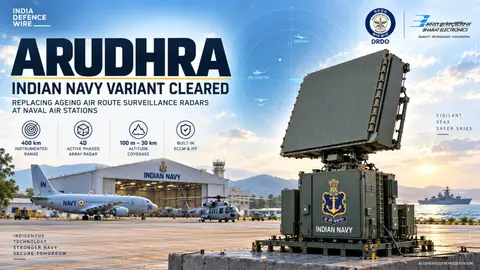
More than a decade and a half after its first delivery, Rohini remains in front-line service across the IAF's ground-based air-defence network, and its design lineage fed directly into the later, higher-power Arudhra medium-power radar.