
 DEFENCE INDUSTRYTata Zorawar light tank clears Army's L1 hurdle for Rs 20,000 crore contract
 DEFENCE INDUSTRYIndia Belgium Defence Deals Sealed As PM De Wever Visits Delhi
 DEFENCE INDUSTRYAero India 2027 Dates Confirmed for February 8 to 12 in Bengaluru
 DEFENCE INDUSTRYJavelin missile co-production advances as Tata Advanced Systems signs Javelin Joint Venture pact
 DEFENCE INDUSTRYTata Lockheed Martin MTA push gets a lift from US envoy's Hyderabad visit
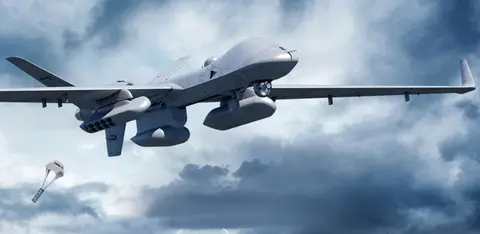
The MQ-9B is a high-altitude, long-endurance (HALE) remotely piloted aircraft built by General Atomics Aeronautical Systems of the United States, marketed in reconnaissance-focused SkyGuardian and maritime-focused SeaGuardian configurations. In October 2024, India signed a tri-service agreement to acquire 31 MQ-9B aircraft, its largest-ever drone purchase and the first major armed unmanned platform bought from a Western supplier, intended to give the Army, Navy and Air Force persistent long-range surveillance and strike reach across the Himalayan frontier and the Indian Ocean Region.
Key facts
- Type/role: High-altitude long-endurance (HALE) remotely piloted aircraft for ISR and armed strike
- Origin/manufacturer: General Atomics Aeronautical Systems, United States
- Endurance: up to around 40 hours
- Ceiling: up to around 40,000 feet
- Payload: up to four AGM-114 Hellfire missiles and roughly 450 kg of GBU-39B precision-guided glide bombs on armed variants
- Status: 31-aircraft deal signed October 2024; deliveries expected to begin around 2029
The India deal
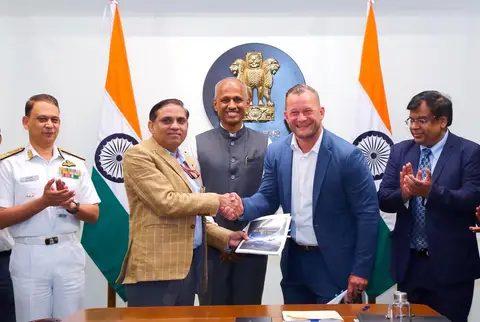
India's Cabinet Committee on Security cleared the MQ-9B purchase in early October 2024, and the government formally signed the agreement on 15 October 2024 for a package reportedly worth well over $3 billion, covering the aircraft, associated munitions and a separate depot-level maintenance, repair and overhaul (MRO) facility. Under the tri-service split, the Indian Navy receives 15 SeaGuardian aircraft while the Army and Air Force each receive eight SkyGuardian aircraft. General Atomics has indicated that 21 of the 31 airframes will be assembled in India, with domestic industry contributing roughly a third of components by value, supporting the government's indigenisation objectives. A companion MRO agreement worth about $420 million provides performance-based logistics support for eight years or 150,000 flying hours, whichever comes first. First deliveries are expected around 2029, with the full fleet handed over within roughly six years of signing.
SkyGuardian and SeaGuardian variants
Both variants share the same core MQ-9B airframe but carry different sensor and mission packages. SkyGuardian, operated by the Army and Air Force, is optimised for overland ISR and can be armed with Hellfire missiles and precision-guided bombs for time-sensitive strike missions. SeaGuardian, operated by the Navy, adds a 360-degree maritime surveillance radar and acoustic processing equipment for anti-submarine warfare, wide-area maritime patrol and over-the-horizon targeting in support of fleet operations.
Capabilities
The MQ-9B is designed to operate beyond line of sight via satellite datalink, allowing controllers to fly missions far from the aircraft's operating base. It is certified to NATO's STANAG 4671 airworthiness standard and fitted with a detect-and-avoid system intended to let it fly routinely in civil airspace alongside crewed traffic, a significant advance over earlier-generation Predator and Reaper variants that required segregated airspace. Its sensor suite typically includes electro-optical/infrared cameras, synthetic aperture radar with ground moving-target indication, and signals-intelligence payloads, giving a single aircraft the ability to track and, where authorised, strike targets over extended periods without returning to base.
Strategic significance
For India, the MQ-9B fills a long-standing gap in persistent high-altitude ISR and armed strike, complementing shorter-range Israeli-origin Heron and Searcher fleets already in service. Deployment is expected to focus on the northern land border with China and on maritime domain awareness across the Indian Ocean, where the SeaGuardian's endurance allows continuous monitoring of shipping lanes and naval movements far beyond the range of manned maritime patrol aircraft.
As deliveries begin later in the decade, the MQ-9B is expected to become the mainstay of India's high-end unmanned ISR and strike capability, operating alongside indigenous programmes such as TAPAS-BH-201 rather than replacing them outright.