
 DEFENCE INDUSTRYBrahMos export orders: Vietnam deal worth about $100 million, Indonesia $200 million as Akash reaches Tajikistan, Turkmenistan
 DEFENCE INDUSTRYMahindra Embraer Nagpur facility to assemble C-390 if IAF picks the aircraft
 DEFENCE INDUSTRYSMPP Drone Manufacturing Push: Firm Shifts From Ammunition to Unmanned Warfare, Targets Integrated Defence Capabilities
 INDIA DEFENCEDhruv NG Helicopter Explained: What HAL Has Actually Put Into Pawan Hans Service
 INDIA DEFENCELCA FOC Trainers Delivered With HTT 40 and Dhruv NG as Rajnath Singh Asks Engineers for Technologies That Do Not Exist
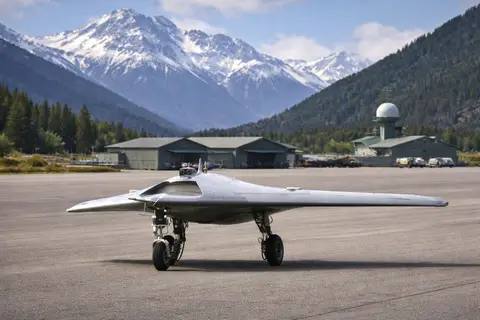
SWiFT, the Stealth Wing Flying Testbed, is a technology-demonstrator programme led by the DRDO to develop the technologies for an autonomous stealth unmanned combat air vehicle (UCAV). It represents the most advanced end of India's ambitions within the field of military drones in India, pointing towards a future combat drone capable of penetrating defended airspace and striking targets that would be too risky for a manned aircraft to reach.
SWiFT is a flying-wing design, a shape chosen for its low radar signature because it avoids the vertical surfaces and sharp angles that reflect radar energy back to an enemy. It is intended to prove the aerodynamics, flight-control software and autonomous take-off and landing needed for a larger combat aircraft. Flying-wing configurations are inherently difficult to control, relying on sophisticated software to remain stable, so demonstrating safe autonomous flight is a significant achievement in itself. SWiFT is best understood as a scaled testbed that reduces the risk of the more ambitious full-size programme, sometimes associated with the name Ghatak, which envisages a stealthy unmanned aircraft able to strike targets deep in hostile territory.
Purpose and current status
DRDO has reported successful flights of the SWiFT demonstrator, validating autonomous take-off, flight and landing, which are key milestones for any UCAV, since such an aircraft must operate without a pilot at the controls. Proving that the aircraft can manage these phases on its own, guided by onboard systems, lays the groundwork for the far more demanding combat aircraft to follow. However, the full combat aircraft remains under development, and precise specifications, timelines and performance figures are not settled, so claims about the eventual system should be treated as provisional. The value of SWiFT lies in maturing the underlying technologies rather than in fielding an operational weapon in the near term.
A stealth UCAV differs fundamentally from surveillance drones such as the imported Heron and Searcher drones or the early indigenous Nishant UAV. Rather than loitering openly to observe, a UCAV is designed to survive in contested airspace where enemy defences are active, and to deliver precision strikes against high-value targets. It complements manned aircraft and offers commanders a way to strike heavily defended targets without risking a pilot, a capability that could reshape how difficult missions are planned.
Significance for future air power
For the Indian Air Force, a home-grown stealth combat drone would mark a major leap in capability and in technological self-reliance, placing India among a small group of nations pursuing such systems, which have proved extremely demanding even for the most advanced aerospace powers. It also connects to the wider trend of manned-unmanned teaming and swarming concepts such as HAL's ALFA-S, in which crewed and uncrewed aircraft operate together as a networked force.
- Design: low-observable flying-wing configuration.
- Role: testbed for an autonomous stealth combat drone.
- Status: demonstrator flown, full UCAV under development.
SWiFT embodies the long-term direction of Indian unmanned aviation: a journey from borrowed surveillance platforms towards indigenous, autonomous combat aircraft designed and built at home. Though the operational UCAV lies in the future and much work remains, the demonstrator marks a deliberate and carefully staged step towards a capability that could reshape how India projects air power in the decades ahead. By first proving the hardest technologies on a smaller, lower-risk aircraft, the programme follows a measured path that many advanced nations have found necessary, reflecting the sheer difficulty of building a stealthy machine that can fly and fight without a pilot on board. If it succeeds, India would gain not only a new weapon but a mastery of the underlying disciplines of stealth shaping, autonomous flight and secure data links, capabilities that would ripple across its wider aerospace and defence efforts for years to come.