
 DEFENCE INDUSTRYBrahMos export orders: Vietnam deal worth about $100 million, Indonesia $200 million as Akash reaches Tajikistan, Turkmenistan
 DEFENCE INDUSTRYMahindra Embraer Nagpur facility to assemble C-390 if IAF picks the aircraft
 DEFENCE INDUSTRYSMPP Drone Manufacturing Push: Firm Shifts From Ammunition to Unmanned Warfare, Targets Integrated Defence Capabilities
 INDIA DEFENCEDhruv NG Helicopter Explained: What HAL Has Actually Put Into Pawan Hans Service
 INDIA DEFENCELCA FOC Trainers Delivered With HTT 40 and Dhruv NG as Rajnath Singh Asks Engineers for Technologies That Do Not Exist
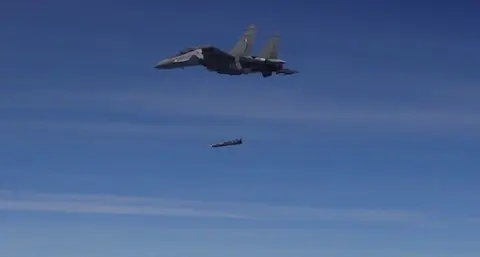
ALFA-S, the Air-Launched Flexible Asset (Swarm), is a swarming munition under development by HAL and Indian research bodies. Designed to be released from an aircraft and to glide towards targets in coordinated groups, it represents India's entry into the emerging field of air-launched drone swarms, an increasingly significant strand within the wider world of military drones in India. As a concept, it points towards a future in which mass is achieved not through large, expensive platforms but through many small cooperating systems.
The concept behind ALFA-S is to carry multiple small, folding-wing drones in a dispenser beneath a manned aircraft. Once released at a safe distance from the objective, the drones deploy their wings and fly towards a target area, potentially saturating enemy air defences, conducting reconnaissance, or striking targets. Because the launching aircraft can stand off well away from the objective, the aircrew are exposed to less risk, while the swarm presents defenders with many targets at once. Confronting a large number of small, low-cost drones simultaneously is far harder than intercepting a single aircraft, and this asymmetry is the central military appeal of the swarm concept.
Concept and current status
ALFA-S has been publicly showcased as a technology demonstrator, notably at Aero India events, where it has drawn attention as a visible sign of India's swarm ambitions. It remains under development rather than in frontline service. As with any programme at this stage, capabilities, payloads and timelines are still being refined, and any specific performance figures should be treated as provisional. The emphasis so far has been on proving the fundamentals: the safe release of the drones from the carrier aircraft, the deployment of their wings, and their coordinated flight towards a designated area.
Swarming munitions are closely related to loitering munitions in that both are expendable and precision-oriented, but the swarm adds the dimension of cooperation, with drones potentially sharing information and dividing tasks. ALFA-S can be seen as complementary to systems such as the Harop and SkyStriker loitering munitions and the indigenous Nagastra-1, differing chiefly in its air launch and its emphasis on cooperative, many-at-once effects rather than a single guided strike.
Significance for the Air Force
For the Indian Air Force, a mature swarm capability would offer a low-cost way to overwhelm defences, gather information and strike targets without risking expensive aircraft over hostile territory. Swarms could be used to expose and exhaust an adversary's air defences, clearing the way for other assets, or to conduct wide-area surveillance that no single drone could achieve. It also aligns with a global trend towards teaming manned aircraft with unmanned systems, where a crewed platform acts as a mother ship or controller for a group of expendable drones.
- Developer: HAL with Indian research partners.
- Concept: aircraft-released swarm of folding-wing glide drones.
- Status: under development and demonstrated publicly.
ALFA-S reflects India's ambition to move beyond individual drones towards networked, cooperative systems that fight as a group. Developed alongside the design capabilities of the DRDO, it signals where Indian air power is heading: towards affordable mass, achieved through many small autonomous systems working together, rather than through ever more expensive individual platforms. Though the operational form of the weapon lies in the future, the concept marks a deliberate step into one of the most closely watched areas of modern warfare. Swarming has drawn intense interest worldwide precisely because it promises to change the arithmetic of air defence, forcing defenders to spend expensive interceptors on cheap attackers, and India's early investment in ALFA-S positions it to explore that shift on its own terms. Success will depend not only on the airframes themselves but on the software that lets them coordinate, share sensor data and adapt if some are lost, which is why much of the hard work in such programmes lies in autonomy and communications rather than in the hardware alone.