
 DEFENCE INDUSTRYBrahMos export orders: Vietnam deal worth about $100 million, Indonesia $200 million as Akash reaches Tajikistan, Turkmenistan
 DEFENCE INDUSTRYMahindra Embraer Nagpur facility to assemble C-390 if IAF picks the aircraft
 DEFENCE INDUSTRYSMPP Drone Manufacturing Push: Firm Shifts From Ammunition to Unmanned Warfare, Targets Integrated Defence Capabilities
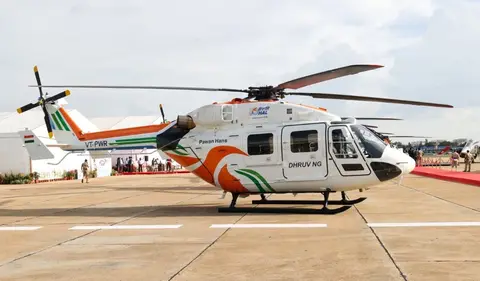 INDIA DEFENCEDhruv NG Helicopter Explained: What HAL Has Actually Put Into Pawan Hans Service
 INDIA DEFENCELCA FOC Trainers Delivered With HTT 40 and Dhruv NG as Rajnath Singh Asks Engineers for Technologies That Do Not Exist
India's drone ecosystem is shaped not only by hardware but by policy. The Drone Rules 2021, together with associated incentive schemes, form the regulatory and industrial framework governing how unmanned aircraft are made, owned and flown. While primarily a civil-aviation instrument, this framework has significant implications for the dual-use and defence sectors, underpinning the wider growth of military drones in India by building the domestic industrial base on which military systems increasingly depend.
The Drone Rules 2021 replaced an earlier, more restrictive regime with a liberalised approach intended to encourage growth while maintaining safety and security. The previous framework had been widely seen as cumbersome, deterring legitimate operators and manufacturers. The new rules sought to change that. Key features included simplified registration and licensing, a sharp reduction in the number of approvals and forms required, the use of a digital platform for registration and flight authorisation, and the definition of airspace zones, typically described as green, yellow and red, for drone operations. The overall aim was to make it easier to build and operate drones legally in India, treating the sector as an opportunity rather than merely a risk to be managed.
Industrial incentives and self-reliance
Alongside the rules, the government introduced a Production Linked Incentive (PLI) scheme for drones and drone components, designed to reward domestic manufacturing and to build a self-reliant industrial base. By tying incentives to production, the scheme aimed to encourage firms to make drones and their key parts in India rather than importing them. Import restrictions on certain foreign drones were also used to protect and stimulate local producers, giving domestic firms space to grow. Together these measures encouraged a wave of Indian start-ups and established firms to enter the sector, expanding the pool of designers, manufacturers and suppliers.
This policy environment matters for defence because much drone technology is dual-use, meaning the same airframes, flight controllers, cameras and communication systems can serve civilian and military purposes. A healthy civil and commercial base therefore strengthens the supply chain for military systems. Indigenous programmes, whether led by the DRDO, public-sector firms such as HAL, or private companies, benefit from a broader pool of domestic components, skills and manufacturers, reducing reliance on imports for critical parts.
Balancing openness and security
Regulation in this field must balance competing pressures. On one hand, it should enable economic growth and innovation; on the other, it must guard against misuse, given that the same technologies that deliver goods or survey fields can also carry contraband or threaten sensitive sites. This tension has driven continuing refinement of the rules, airspace management and enforcement, and it is closely linked to investment in counter-drone systems to manage rogue or hostile UAVs. Policy and protective technology thus advance together, each shaping the other.
- Simplification: fewer approvals and digital registration and authorisation.
- Incentives: a PLI scheme and import measures to favour domestic makers.
- Balance: promoting growth while managing safety and security risks.
The Drone Rules 2021 and the surrounding policy framework illustrate that building a drone power is as much about regulation and industry as about individual aircraft. By fostering a domestic ecosystem of manufacturers, operators and suppliers, India aims to ensure that the systems its armed forces field, from surveillance platforms to loitering munitions, can increasingly be designed and built at home. In this way, an apparently civilian set of rules becomes a foundation for national capability. A country that manufactures drones and their components at scale for agriculture, logistics and surveying also gains the skilled workforce, the factories and the supply chains that a resilient defence industry needs, which is why policy in this area is watched as closely by planners in uniform as by entrepreneurs.