
 DEFENCE INDUSTRYBrahMos export orders: Vietnam deal worth about $100 million, Indonesia $200 million as Akash reaches Tajikistan, Turkmenistan
 DEFENCE INDUSTRYMahindra Embraer Nagpur facility to assemble C-390 if IAF picks the aircraft
 DEFENCE INDUSTRYSMPP Drone Manufacturing Push: Firm Shifts From Ammunition to Unmanned Warfare, Targets Integrated Defence Capabilities
 INDIA DEFENCEDhruv NG Helicopter Explained: What HAL Has Actually Put Into Pawan Hans Service
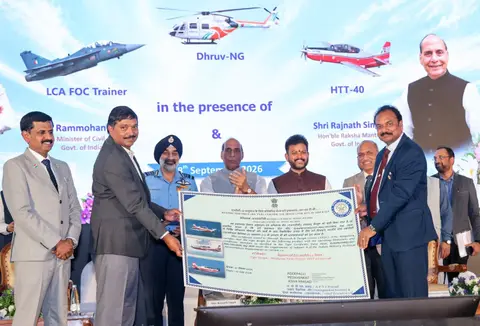 INDIA DEFENCELCA FOC Trainers Delivered With HTT 40 and Dhruv NG as Rajnath Singh Asks Engineers for Technologies That Do Not Exist
Nishant was one of India's earliest indigenous tactical unmanned aerial vehicles, developed by the DRDO through its Aeronautical Development Establishment. Conceived as a battlefield reconnaissance and surveillance platform for the Indian Army, it holds an important place in the history of military drones in India as a formative domestic design that proved the country could build such systems at home.
Nishant was intended to provide intelligence, surveillance, target acquisition and reconnaissance, carrying electro-optical and infrared payloads to observe enemy positions and support artillery fire. It was designed to serve the field commander directly, providing a real-time view of the battlefield beyond the range of ground observers. A distinctive feature of the design was its catapult launch and parachute recovery, which allowed it to operate without a prepared runway. For a mobile land force that may not have access to airfields near the front, this rail-launched, air-bag-cushioned recovery approach was an attractive characteristic, offering flexibility in where and how the drone could be deployed.
Development and legacy
As an early programme, Nishant faced the challenges typical of pioneering indigenous efforts, including reliability and operational refinement over the course of trials and limited service. Developing a rugged unmanned aircraft, its ground control station, launch and recovery equipment and sensor payloads simultaneously was a demanding undertaking for a first-generation domestic effort, and the programme worked through numerous technical hurdles along the way.
A related variant known as Panchi was developed with a wheeled undercarriage for conventional runway operation, extending the design's endurance by removing the weight and drag associated with the catapult and parachute system. While Nishant was produced only in small numbers and did not become a large-scale mainstay, its true value lay in the experience it generated for engineers and operators alike. The lessons learned fed directly into DRDO's more ambitious Rustom series of medium-altitude, long-endurance UAVs, and into the broader national effort to build capable indigenous drones.
In this sense Nishant served as a stepping stone, comparable in intent to the imported Heron and Searcher drones that were fielded to meet urgent operational needs while domestic designs matured. The two approaches, buying proven foreign systems and developing home-grown ones, ran in parallel and together shaped India's unmanned aviation.
Significance in India's drone journey
Nishant demonstrated that India could design, build and fly a tactical UAV domestically, establishing engineering capabilities in aerodynamics, flight control, data links and sensor integration that later programmes would build upon. It also underlined the difficulty of translating a technology demonstrator into a rugged, mass-produced service platform, a challenge that has shaped subsequent Indian drone development and informed how later projects were structured.
- Developer: DRDO's Aeronautical Development Establishment.
- Role: tactical reconnaissance and artillery observation.
- Feature: catapult launch and parachute recovery, with a runway variant, Panchi.
Today Nishant is best understood as a precursor, a design whose importance is measured less by the numbers fielded than by the indigenous know-how it created. That foundation supports India's continuing push, now increasingly alongside private industry, towards advanced unmanned systems that range from long-endurance surveillance platforms to the stealth combat drones now under development. The experience gained in the Nishant era helped make those later ambitions credible, marking it as a quiet but significant milestone in the story of Indian drones. It taught a generation of engineers and operators how unmanned aircraft behave in the field, what their control stations and launch systems require, and how imagery from a drone can be turned into useful intelligence for a commander, lessons that no imported system could fully impart. That accumulated knowledge, built up through years of trials and setbacks, is arguably the programme's most enduring legacy, and it continues to inform how India approaches the design and induction of unmanned systems today.