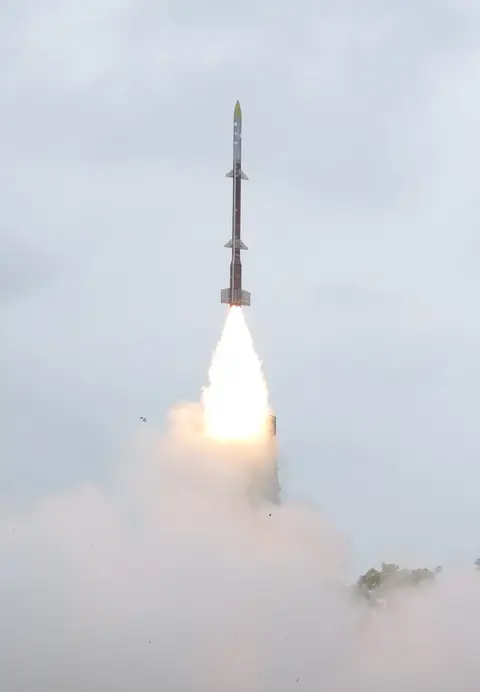

 DEFENCE INDUSTRYBrahMos export orders: Vietnam deal worth about $100 million, Indonesia $200 million as Akash reaches Tajikistan, Turkmenistan
 DEFENCE INDUSTRYMahindra Embraer Nagpur facility to assemble C-390 if IAF picks the aircraft
 DEFENCE INDUSTRYSMPP Drone Manufacturing Push: Firm Shifts From Ammunition to Unmanned Warfare, Targets Integrated Defence Capabilities
 INDIA DEFENCEDhruv NG Helicopter Explained: What HAL Has Actually Put Into Pawan Hans Service
 INDIA DEFENCELCA FOC Trainers Delivered With HTT 40 and Dhruv NG as Rajnath Singh Asks Engineers for Technologies That Do Not Exist
As drones proliferate, so does the need to defend against them. India has invested in a range of counter-drone, or counter-unmanned aerial system (C-UAS), technologies to detect, track and neutralise hostile UAVs, from small commercial quadcopters to armed military platforms. These defensive tools are the necessary counterpart to the offensive and surveillance roles within the wider field of military drones in India, and their importance has grown as small drones have been used for smuggling, surveillance and attacks along India's borders.
Counter-drone defence typically works in layers, beginning with the difficult problem of detection. Small drones fly low and slow and have a tiny radar signature, which means conventional air-defence radars designed to spot aircraft and missiles may miss them. To close this gap, C-UAS systems combine radar, radio-frequency sensors that listen for control signals, electro-optical and infrared cameras, and acoustic devices that detect the characteristic sound of drone motors. Fusing these different sensors improves the chance of spotting a threat and reduces false alarms from birds or clutter.
Detection and defeat methods
Once a threat is identified, it can be defeated by soft-kill or hard-kill means. Soft-kill methods include jamming the drone's control and navigation signals, or spoofing its satellite positioning, to force it to land, return to its operator or lose its way. These non-destructive methods are attractive in populated areas because they avoid falling debris and can neutralise a drone without an explosion. Hard-kill methods, by contrast, use kinetic effectors such as guns, small missiles or interceptor drones to physically destroy the target when its destruction is necessary.
A growing area of interest is directed-energy weapons, including laser systems that can burn through a drone's structure at the speed of light. Their appeal lies in a very low cost per shot compared with missiles, making them well matched to cheap, numerous threats. Indian development in this field draws heavily on the DRDO and manufacturing partners such as BEL, alongside private firms. DRDO has publicly demonstrated an anti-drone system combining detection with both jamming and laser-based hard kill, and several such capabilities have reportedly been deployed to protect sensitive sites and forward areas.
Integration with air defence
Counter-drone systems are most effective when woven into the broader air-defence network rather than operating in isolation, because a lone sensor or jammer can be overwhelmed or bypassed. They connect with military radar systems and command-and-control frameworks such as Akashteer, which allow small drone threats to be handled alongside conventional aircraft and missile defences that include weapons like Akash. This integration ensures that the right effector, whether a jammer, a gun or a missile, is matched to each threat.
- Detect: radar, radio-frequency, electro-optical and acoustic sensors.
- Soft-kill: jamming and spoofing of control and navigation.
- Hard-kill: guns, interceptors and directed-energy lasers.
The counter-drone challenge is dynamic, as adversaries continually adopt swarms, greater autonomy and low-cost mass to overwhelm defences. India's forces, including the Indian Army, continue to refine layered defences that combine sensors and effectors to meet a threat that has moved from the margins to the centre of modern security planning. As drones become cheaper and more capable, this field is likely to remain one of the most active and fast-moving areas of defence development. Each advance in offensive drones tends to prompt a matching advance in the systems that counter them, so investment in detection, jamming and directed energy must be continuous rather than one-off if defences are to keep pace with the threat. Protecting airports, power stations, military bases and border areas against small drones has become a routine security requirement, and the same technologies that guard the battlefield are increasingly needed to protect civilian infrastructure and major public events as well.