
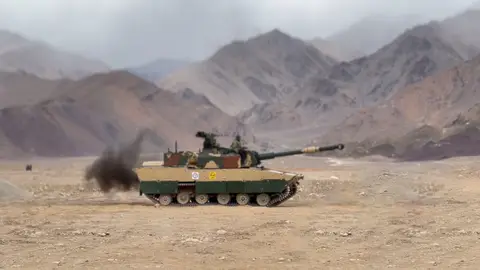
 DEFENCE INDUSTRYTata Zorawar light tank clears Army's L1 hurdle for Rs 20,000 crore contract
 DEFENCE INDUSTRYIndia Belgium Defence Deals Sealed As PM De Wever Visits Delhi
 DEFENCE INDUSTRYAero India 2027 Dates Confirmed for February 8 to 12 in Bengaluru
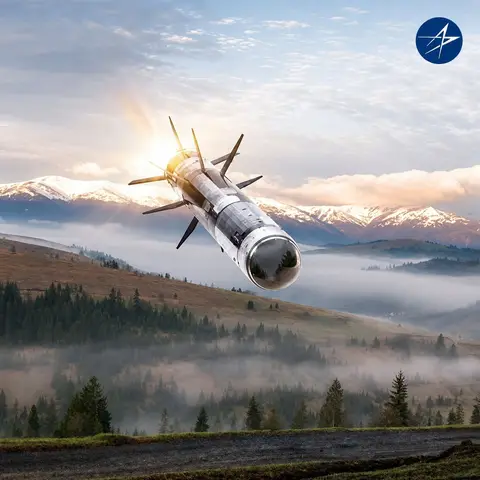 DEFENCE INDUSTRYJavelin missile co-production advances as Tata Advanced Systems signs Javelin Joint Venture pact
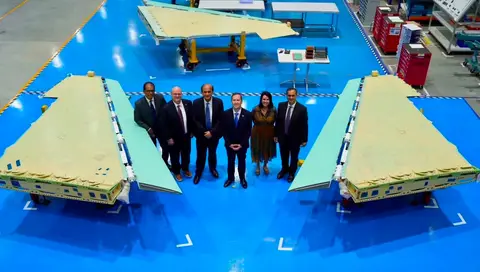 DEFENCE INDUSTRYTata Lockheed Martin MTA push gets a lift from US envoy's Hyderabad visit
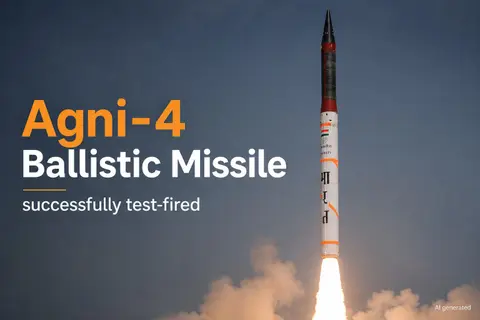
The Agni series is India's principal family of surface-to-surface ballistic missiles, developed by the Defence Research and Development Organisation (DRDO) and forming the backbone of the country's land-based strategic deterrent. Spanning short-range Agni-I through to the intercontinental-class Agni-V, the series traces its origin to a 1980s technology demonstrator for re-entry vehicles and has since evolved into a family of road-mobile, canisterised, nuclear-capable systems.
Key facts
- Type: family of surface-to-surface ballistic missiles, short-range to intercontinental-class
- Developer: DRDO, principally the Advanced Systems Laboratory, Hyderabad
- Propulsion: solid-fuel, single to multi-stage depending on variant
- Range span: roughly 700 km (Agni-I) to over 5,000 km (Agni-V, officially classified as an intermediate-range ballistic missile)
- Warhead: nuclear or conventional payloads; Agni-V demonstrated Multiple Independently Targetable Re-entry Vehicle (MIRV) capability in 2024
- Launch mode: road-mobile, and canisterised in later variants for faster launch readiness and easier storage
- Status: Agni-I to Agni-V and Agni-Prime in service or advanced trials with the Strategic Forces Command
Variants
- Agni-I: a single-stage, solid-fuel missile with a range of roughly 700-900 km, inducted in the mid-2000s as a short-range deterrent
- Agni-II: a two-stage medium-range missile with a range of approximately 2,000-2,500 km
- Agni-III: a two-stage missile extending range to roughly 3,000-5,000 km, capable of covering targets across most of China
- Agni-IV: an intermediate step between Agni-II and Agni-III, with a range of around 3,000-4,000 km and a lighter, more compact airframe using composite materials
- Agni-V: a three-stage, canisterised missile with a range in excess of 5,000 km, first tested in 2012 and India's longest-range operational ballistic missile
- Agni-Prime (Agni-P): a newer-generation, two-stage canisterised missile with a range of up to 2,000 km, designed as a lighter and more accurate replacement for the Agni-I and Agni-II
Mission Divyastra and MIRV capability
In March 2024, DRDO conducted Mission Divyastra, the first flight test of an Agni-V missile fitted with indigenously developed Multiple Independently Targetable Re-entry Vehicle (MIRV) technology, allowing a single missile to deliver several warheads to separate targets. The test made India one of a small group of nations, alongside the United States, Russia, the United Kingdom, France and China, with demonstrated MIRV capability, significantly enhancing the penetration value of the Agni-V against ballistic missile defences.
Development and doctrine
The Agni programme began as a re-entry vehicle technology demonstrator under the Integrated Guided Missile Development Programme, first flight-tested in 1989. Early variants relied on a mix of solid and liquid propulsion stages; later variants moved to all solid-fuel designs for faster launch readiness and reduced logistical burden. Agni missiles are operated by the tri-service Strategic Forces Command and underpin India's declared doctrine of credible minimum deterrence and no-first-use of nuclear weapons.
Operational significance
Successive Agni variants have progressively extended India's reach from a regional deterrent focused on its immediate neighbourhood to a strategic capability that some analysts assess could extend to intercontinental range, though India officially classifies Agni-V as an intermediate-range system. Canisterisation of later variants, beginning with Agni-III and standard on Agni-Prime and Agni-V, has substantially reduced pre-launch preparation time and improved survivability by allowing missiles to be stored and transported in a ready-to-fire state.
Command and future development
All Agni variants are operated by the tri-service Strategic Forces Command, which reports directly to India's Nuclear Command Authority rather than to a single service, reflecting the missiles' role as national strategic assets rather than battlefield weapons. DRDO continues to refine guidance, propulsion and warhead technology across the family, with reported work on further range extension, improved re-entry vehicles and expanded MIRV payloads intended to keep the Agni series credible against evolving regional ballistic missile defence networks.
Taken together, the Agni series represents four decades of continuous Indian investment in indigenous ballistic missile technology, evolving from a single re-entry demonstrator into a layered, MIRV-capable strategic deterrent.