
 DEFENCE INDUSTRYBrahMos export orders: Vietnam deal worth about $100 million, Indonesia $200 million as Akash reaches Tajikistan, Turkmenistan
 DEFENCE INDUSTRYMahindra Embraer Nagpur facility to assemble C-390 if IAF picks the aircraft
 DEFENCE INDUSTRYSMPP Drone Manufacturing Push: Firm Shifts From Ammunition to Unmanned Warfare, Targets Integrated Defence Capabilities
 INDIA DEFENCEDhruv NG Helicopter Explained: What HAL Has Actually Put Into Pawan Hans Service
 INDIA DEFENCELCA FOC Trainers Delivered With HTT 40 and Dhruv NG as Rajnath Singh Asks Engineers for Technologies That Do Not Exist
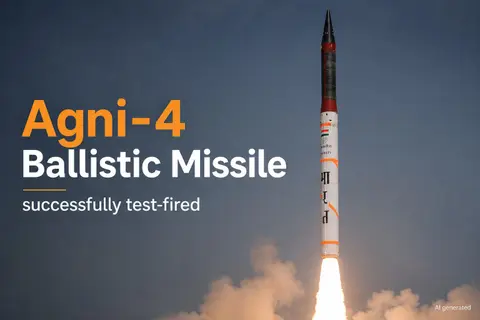
Agni Prime, also designated Agni-P, is a newer-generation ballistic missile developed by the Defence Research and Development Organisation (DRDO). It has been widely reported as a more compact, canisterised and road-mobile system intended to modernise and eventually replace some of India's older Agni variants, offering improved handling, storability and launch readiness. It forms part of the broader family of missiles in India that anchors the country's deterrent.
A new generation of the Agni line
The Agni programme has evolved over several decades, moving from early liquid- and solid-fuelled designs towards modern, quick-reaction systems. Agni Prime represents the latest thinking in this evolution, applying lessons learned from earlier variants to produce a lighter and more manageable missile. It is generally placed in the medium-range class, positioned between shorter-range systems and the intercontinental-class Agni-V.
The design goal has been to combine proven reliability with modern materials and electronics, reducing weight while maintaining or improving performance. This reflects a wider maturation of India's strategic technology base, which began with pioneering efforts such as the Prithvi family and has since produced increasingly sophisticated systems.
Design and features
Agni Prime is described as a two-stage, solid-fuelled missile that incorporates lighter composite structures and refined guidance compared with earlier Agni designs. A defining feature is its canisterisation, in which the missile is stored and transported inside a sealed container that doubles as the launch tube. This approach reduces maintenance demands, protects the missile from the environment and allows it to be fielded on mobile launchers, improving survivability by complicating detection and targeting.
Publicly reported development flight tests have been described as validating its propulsion, navigation and re-entry performance, though precise range and payload figures are generally stated only in broad terms. The emphasis throughout has been on rapid readiness, so that the missile can be launched with minimal preparation from dispersed locations, an important quality for a survivable deterrent.
The road-mobile basing means that launch units can be moved between hardened or concealed positions rather than tied to fixed sites, which are easier for an adversary to locate and neutralise. This mobility, combined with the sealed canister, allows units to remain ready for extended periods with limited maintenance. Such design choices are typical of modern strategic missiles worldwide and mark a clear advance over the more labour-intensive systems that preceded them in Indian service.
Role and strategic context
Agni Prime is intended for India's strategic forces and reflects a wider trend across the Agni programme towards canisterised, quick-reaction, road-mobile systems. This mirrors the modernisation of other elements within India's missile inventory, where legacy liquid-fuelled and rail-based concepts have progressively given way to solid-fuelled, container-launched designs. By streamlining logistics and cutting the time between order and launch, Agni Prime is meant to strengthen the credibility of India's deterrent.
The system complements the intercontinental-class Agni-V at the longer end of the spectrum. Alongside the sea-based K-15 and K-4 submarine-launched missiles, these land systems contribute to India's layered strategic posture and its declared no-first-use policy. Their deployment and maintenance are supported by the conventional formations of the Indian Army, which underpin strategic operations.
- Type: Canisterised, road-mobile ballistic missile
- Propulsion: Two-stage solid propellant
- Class: Medium-range
- Developer: DRDO with Indian industry partners
Significance
Agni Prime has been widely reported as an important step in refreshing India's medium-range deterrent, blending the reliability of proven solid-propellant technology with modern materials and electronics. Its emphasis on mobility and rapid readiness aligns with the operational needs of the strategic forces. As successive tests progress towards induction, Agni Prime is expected to become a mainstay that improves the flexibility and resilience of India's land-based missile forces, part of a broader push for indigenous capability across the country's defence ecosystem.