

 DEFENCE INDUSTRYBrahMos export orders: Vietnam deal worth about $100 million, Indonesia $200 million as Akash reaches Tajikistan, Turkmenistan
 DEFENCE INDUSTRYMahindra Embraer Nagpur facility to assemble C-390 if IAF picks the aircraft
 DEFENCE INDUSTRYSMPP Drone Manufacturing Push: Firm Shifts From Ammunition to Unmanned Warfare, Targets Integrated Defence Capabilities
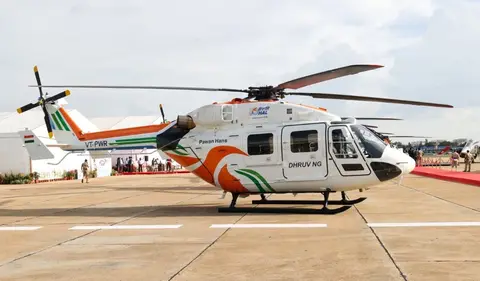 INDIA DEFENCEDhruv NG Helicopter Explained: What HAL Has Actually Put Into Pawan Hans Service
 INDIA DEFENCELCA FOC Trainers Delivered With HTT 40 and Dhruv NG as Rajnath Singh Asks Engineers for Technologies That Do Not Exist
The Quick Reaction Surface-to-Air Missile, commonly abbreviated as QRSAM, is a mobile short-range air-defence system developed by the Defence Research and Development Organisation (DRDO). It is designed to protect moving field formations from aerial threats and has been widely reported as nearing induction with the Indian Army. QRSAM is one of the newer entries in the family of missiles in India aimed at the lower tier of air defence.
Design and purpose
QRSAM is built around mobility and rapid reaction. Its launchers and radars are mounted on high-mobility vehicles so that the system can accompany armoured and mechanised columns and provide air cover on the move or after only short halts. A key stated capability is the ability to search and track while moving and to engage targets very quickly after halting, minimising the window during which advancing troops are exposed to air attack.
This capability is particularly valuable for shielding the country's armoured formations from aircraft, helicopters and other aerial threats as they advance. Older air-defence systems that require lengthy set-up are less suited to keeping pace with fast-moving forces, and QRSAM is intended to close that gap.
System components
The missile is a solid-fuelled design intended for short-range engagements, using modern seeker and guidance technology to intercept agile targets. Each firing unit integrates radars for search, track and fire control, giving it a largely self-contained engagement capability. This tight integration of sensors, launchers and command systems onto mobile platforms reflects a broader trend in Indian air defence towards networked, deployable units. As with many systems in development, precise range and performance figures are generally described in broad terms.
The ability to search on the move is a demanding technical requirement, because a radar must maintain a stable picture while its vehicle is travelling over uneven ground. Solving this problem allows an air-defence unit to remain alert throughout an advance rather than being effectively blind whenever it moves. Each unit is designed to engage more than one target and to be relocated quickly after firing, reducing its vulnerability to counter-attack. These qualities make the system well suited to the fluid conditions of mobile warfare.
Place in India's air defence
QRSAM fills an important gap in India's layered air-defence architecture, sitting below medium-range systems such as Akash and well below long-range imported systems like the S-400 Triumf. Together these layers are intended to provide overlapping coverage against threats at different ranges and altitudes, so that a target penetrating one layer can still be engaged by another. QRSAM's specific contribution is the protection of mobile forces, an area where fixed or slower-to-deploy systems are less effective. Its performance depends on integration with the wider network of military radar systems and command links.
- Type: Quick-reaction, short-range surface-to-air missile system
- Mobility: Vehicle-mounted launchers and radars for on-the-move operation
- Role: Air defence of advancing field formations
- Developer: DRDO
Significance
QRSAM has been reported through a series of successful development trials as a promising indigenous addition to India's air-defence inventory, offering the mobility and speed needed to protect forces in the field. Its induction would reduce reliance on ageing imported short-range systems and reinforce the broader indigenous ecosystem. Within the wider landscape of missiles in India, QRSAM strengthens the lower tier of air defence and complements the country's growing suite of homegrown surface-to-air systems, contributing to a more complete and self-reliant defensive shield. Its emphasis on protecting forces in the field rather than fixed sites addresses a long-standing requirement of mobile warfare, and its successful development would mark another step in the maturing of India's indigenous air-defence industry. Taken together with medium- and long-range systems, it helps ensure that Indian forces can operate under a continuous protective umbrella wherever they move.