
 DEFENCE INDUSTRYBrahMos export orders: Vietnam deal worth about $100 million, Indonesia $200 million as Akash reaches Tajikistan, Turkmenistan
 DEFENCE INDUSTRYMahindra Embraer Nagpur facility to assemble C-390 if IAF picks the aircraft
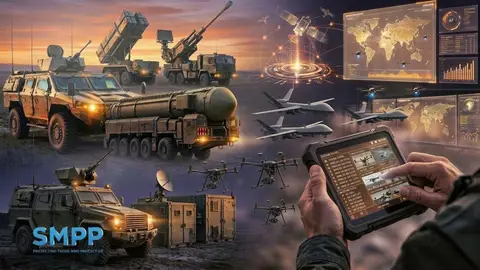 DEFENCE INDUSTRYSMPP Drone Manufacturing Push: Firm Shifts From Ammunition to Unmanned Warfare, Targets Integrated Defence Capabilities
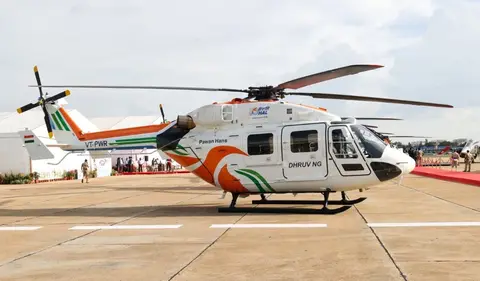 INDIA DEFENCEDhruv NG Helicopter Explained: What HAL Has Actually Put Into Pawan Hans Service
 INDIA DEFENCELCA FOC Trainers Delivered With HTT 40 and Dhruv NG as Rajnath Singh Asks Engineers for Technologies That Do Not Exist
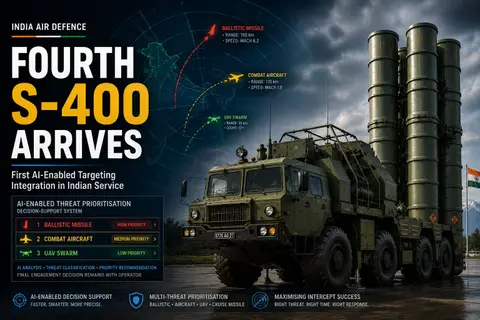
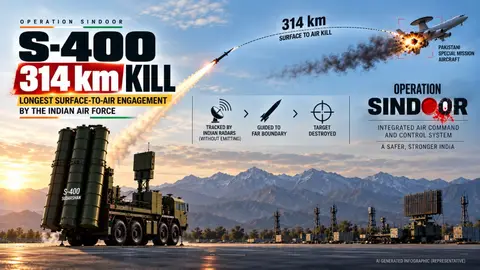
The S-400 Triumf is a long-range surface-to-air missile system of Russian origin acquired by India to anchor the top tier of its air-defence network. Unlike most systems described in the overview of missiles in India, the S-400 is an imported platform, and its induction has been widely reported as a significant enhancement of the country's ability to defend its airspace against a broad range of aerial threats.
Capabilities
The S-400 is designed as a layered air-defence system that can employ different types of missile to engage targets at varying ranges and altitudes. It is intended to counter aircraft, cruise missiles and certain other aerial threats at long distances, using powerful radars for early detection and tracking. A single deployed unit can, in principle, cover a wide area, making it a strategic asset for protecting high-value regions, cities and installations.
The system's strength lies not only in its long reach but in its ability to detect and track many targets at once and to allocate the most appropriate missile to each. This flexibility allows a single regiment to defend against a mixed raid of different threat types, which is why such systems are considered among the most capable ground-based air-defence assets in the world.
A further advantage of a long-range system is the way it can shape an adversary's behaviour even without firing. The knowledge that aircraft may be engaged at great distance can push opposing forces to fly lower, stand off further or expend effort on suppression, all of which complicate their operations. This deterrent effect, sometimes described as the creation of a denied zone, is one reason such systems are valued as strategic assets rather than purely tactical ones.
Role in India's air defence
Operation of the system in Indian service is associated with the Indian Air Force, which manages the country's ground-based air-defence assets in coordination with the other services and the field formations of the Indian Army. The S-400 occupies the long-range tier of a layered architecture. Below it sit medium-range indigenous systems such as Akash and quick-reaction short-range systems like QRSAM.
The intent of such a layered design is that threats which penetrate the outer long-range layer can still be engaged by shorter-ranged systems closer in, creating overlapping coverage from high altitude down to low level. Effective operation depends heavily on integration with India's broader military radar systems and command-and-control networks, so that tracks can be shared across units and engagements coordinated rather than duplicated.
- Type: Long-range surface-to-air missile system
- Origin: Imported from Russia
- Role: Top-tier, long-range air defence
- Operator: Indian Air Force
Significance and context
The acquisition of the S-400 has been described as one of India's most significant recent air-defence decisions, giving the country a long-reach capability while indigenous long-range programmes mature. Reports indicate that deliveries and the raising of operational regiments have proceeded in phases. While the S-400 is not an Indian-made system, it forms an important part of the overall picture alongside the country's growing family of homegrown weapons. Over the longer term, indigenous long-range air-defence efforts are expected to complement and eventually broaden the capability the S-400 currently provides, deepening the self-reliance of India's defence ecosystem while retaining the reach that the imported system offers today. In the meantime, the presence of a proven long-range system allows Indian planners to protect their most valuable assets with confidence and to gain operational experience with a modern integrated air-defence network. That experience, in turn, informs the requirements and design of the home-grown systems intended to follow, making the S-400 both a capability in its own right and a benchmark for future indigenous development.