
 DEFENCE INDUSTRYBrahMos export orders: Vietnam deal worth about $100 million, Indonesia $200 million as Akash reaches Tajikistan, Turkmenistan
 DEFENCE INDUSTRYMahindra Embraer Nagpur facility to assemble C-390 if IAF picks the aircraft
 DEFENCE INDUSTRYSMPP Drone Manufacturing Push: Firm Shifts From Ammunition to Unmanned Warfare, Targets Integrated Defence Capabilities
 INDIA DEFENCEDhruv NG Helicopter Explained: What HAL Has Actually Put Into Pawan Hans Service
 INDIA DEFENCELCA FOC Trainers Delivered With HTT 40 and Dhruv NG as Rajnath Singh Asks Engineers for Technologies That Do Not Exist
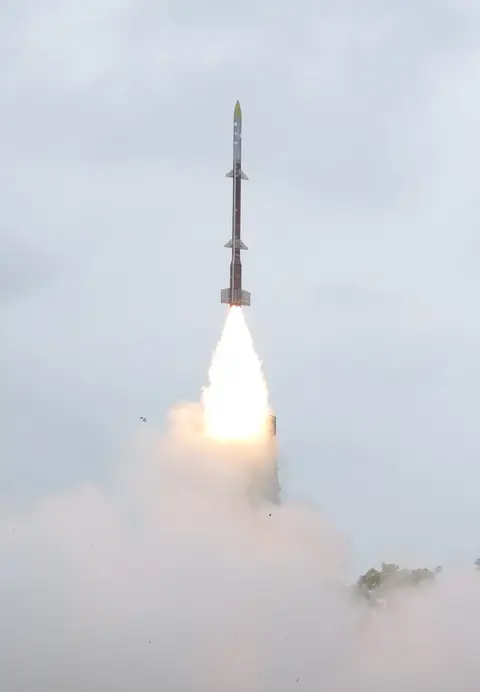
Akash is an indigenous medium-range surface-to-air missile (SAM) system developed to protect vital installations and field formations from aerial threats. Designed by the Defence Research and Development Organisation (DRDO) and produced with Indian defence firms, Akash is one of the most widely fielded homegrown air-defence systems and serves with both the Indian Army and the Indian Air Force.
System architecture
An Akash battery combines launchers, command posts and radars into an integrated, largely mobile system able to engage aircraft, helicopters and other aerial targets at medium range. A central element is its association with the Rajendra phased-array radar, which provides target tracking and missile guidance. This lets a single battery track multiple targets and guide missiles against several of them simultaneously, giving commanders a flexible layer of defence.
The Akash missile itself uses a solid-propellant boost with sustained propulsion and is command-guided in its core variant, receiving steering commands from the ground based on radar tracking. This architecture was chosen to keep the missile relatively simple and cost-effective while placing the more complex sensing and computing on the ground segment, which can be maintained and upgraded more easily.
Because the system is largely mobile, its elements can be moved to protect different assets as the threat picture changes, whether shielding a forward airbase, a headquarters or an advancing formation. The ability to engage several targets at once is particularly important against coordinated air raids, where multiple aircraft or weapons may approach simultaneously. In practice a battery works as part of a wider network, receiving early warning from other radars and passing on its own track data, so that engagements can be shared efficiently across the air-defence organisation.
Indigenous production
Production of the missiles and associated systems has drawn on a broad base of Indian industry. Missile manufacture has been associated with Bharat Dynamics Limited (BDL), while much of the electronics and radar work has involved Bharat Electronics Limited (BEL). This wide industrial participation has made Akash an important example of self-reliance in a complex, systems-of-systems weapon, and it has also generated export interest from other countries.
Variants and evolution
Beyond the original system, DRDO has reported work on improved versions. Akash-NG (New Generation) is described as a more compact missile with a modern seeker and improved range and reaction time, intended to counter faster and more agile targets while reducing the footprint of each firing unit. Other upgraded variants have focused on better performance and easier deployment. Akash sits within a layered air-defence picture alongside quick-reaction systems such as the QRSAM and long-range imported systems like the S-400 Triumf, together providing overlapping coverage at different ranges.
- Type: Medium-range surface-to-air missile system
- Guidance: Command guidance in core variant, improved seekers in newer versions
- Key radar: Rajendra phased-array radar
- Services: Indian Army and Indian Air Force
Significance
Akash has been widely reported as a cornerstone of India's indigenous air-defence capability and a notable success in reducing dependence on imported systems. Its induction demonstrated the ability to integrate missiles, radars and command systems into a coherent networked whole, an achievement that fed into later Indian programmes. Within the broader landscape of missiles in India, Akash occupies the important medium-range band. As Akash-NG and related upgrades progress, the system is expected to remain central to protecting Indian airspace, complemented by other elements of the country's military radar systems and command networks. The long production run and steady stream of improvements have also helped sustain a skilled workforce and supply chain, ensuring that the knowledge gained is retained and built upon rather than lost between programmes. For many observers, Akash stands as proof that India can field a complete, networked air-defence system largely of its own design.