
 DEFENCE INDUSTRYTata Zorawar light tank clears Army's L1 hurdle for Rs 20,000 crore contract
 DEFENCE INDUSTRYIndia Belgium Defence Deals Sealed As PM De Wever Visits Delhi
 DEFENCE INDUSTRYAero India 2027 Dates Confirmed for February 8 to 12 in Bengaluru
 DEFENCE INDUSTRYJavelin missile co-production advances as Tata Advanced Systems signs Javelin Joint Venture pact
 DEFENCE INDUSTRYTata Lockheed Martin MTA push gets a lift from US envoy's Hyderabad visit
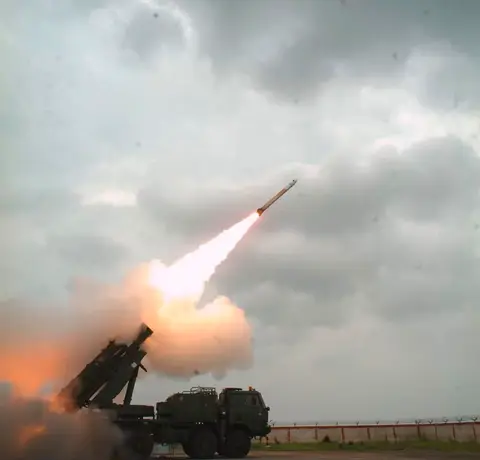
Pralay is a short-range, quasi-ballistic surface-to-surface missile developed by the Defence Research and Development Organisation (DRDO) for conventional battlefield strikes. It is designed to give Indian forces a precise, hard-to-intercept option for hitting tactical targets such as command posts, logistics nodes, radars and troop concentrations, and it is one of the more recent additions to the family of missiles in India.
Quasi-ballistic design
Unlike a purely ballistic missile that follows a predictable arcing trajectory, a quasi-ballistic missile such as Pralay can perform manoeuvres during flight and follow a flatter, adjustable path. This makes its trajectory harder to predict and intercept, improving the chances of reaching heavily defended targets. The ability to change course in flight also complicates the task of any opposing air-defence system attempting to compute an interception.
Pralay is a solid-fuelled missile intended for the short-range battlefield role, a choice that supports storability, mobility and rapid launch. It is described as carrying a conventional warhead, which distinguishes it from the strategic, nuclear-oriented systems in India's inventory and places it firmly in the category of conventional precision-strike weapons.
Battlefield role
Because it is a conventional tactical weapon, Pralay is aimed at the operational needs of the Indian Army and, in reported plans, the Indian Air Force. It offers commanders a responsive means of striking targets deep in the tactical battle area without resorting to strategic systems, filling the gap between shorter-range battlefield rockets and longer-range strategic ballistic missiles.
Such a capability allows for precise, conventional strikes against high-value targets early in an engagement, potentially degrading an opponent's ability to respond. The missile's road mobility means launch units can be dispersed, moved and concealed, improving both survivability and operational flexibility.
A conventional battlefield missile of this kind gives commanders a way to reach targets beyond the range of artillery and rockets without committing aircraft to defended airspace. Because it carries a conventional rather than a strategic warhead, it can be used in situations where the threshold for employing weapons is lower, broadening the circumstances in which precise long-range fire can be brought to bear. Its manoeuvring flight profile is intended to give it a reasonable chance of penetrating an opponent's missile defences to strike the intended target.
Place in the arsenal
Pralay complements older short-range systems such as the Prithvi family while offering a more modern, manoeuvring, solid-fuelled design. It sits well below the strategic, nuclear-capable systems such as Agni Prime in both range and role, being intended for conventional theatre use rather than deterrence. In this way it broadens the range of options available to commanders across the full spectrum of conflict.
- Type: Short-range quasi-ballistic surface-to-surface missile
- Warhead: Conventional
- Propulsion: Solid propellant
- Developer: DRDO
Significance
Pralay has been widely reported as an important addition to India's conventional precision-strike options, giving field commanders a manoeuvring missile that is difficult to intercept and suited to modern battlefield needs. Its development reflects a broader trend towards accurate, solid-fuelled, road-mobile tactical systems that can be fielded quickly and dispersed easily. Within the wider family of missiles in India, Pralay strengthens the conventional tactical tier, complementing anti-armour weapons such as the Nag anti-tank guided missile and reinforcing the country's ongoing drive for self-reliance in guided weapons across its defence ecosystem. By adding a precise, conventional deep-strike option, it gives Indian forces the means to hold key enemy assets at risk without escalating to strategic weapons, an increasingly important capability in modern conventional deterrence. Reports of interest from more than one service suggest that the missile could be fielded fairly widely, spreading the benefits of the development effort and helping to establish quasi-ballistic technology as a lasting part of India's conventional arsenal.