
 DEFENCE INDUSTRYBrahMos export orders: Vietnam deal worth about $100 million, Indonesia $200 million as Akash reaches Tajikistan, Turkmenistan
 DEFENCE INDUSTRYMahindra Embraer Nagpur facility to assemble C-390 if IAF picks the aircraft
 DEFENCE INDUSTRYSMPP Drone Manufacturing Push: Firm Shifts From Ammunition to Unmanned Warfare, Targets Integrated Defence Capabilities
 INDIA DEFENCEDhruv NG Helicopter Explained: What HAL Has Actually Put Into Pawan Hans Service
 INDIA DEFENCELCA FOC Trainers Delivered With HTT 40 and Dhruv NG as Rajnath Singh Asks Engineers for Technologies That Do Not Exist
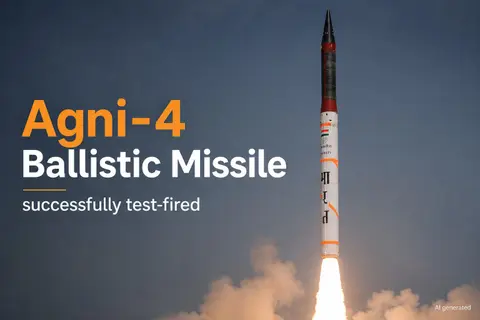
The Agni-V is India's longest-range ballistic missile and is widely regarded as the flagship of the country's land-based strategic deterrent. Developed by the Defence Research and Development Organisation (DRDO), it is a solid-fuelled, road-mobile missile intended to give India an assured retaliatory capability against distant adversaries. It is the most capable member of the wider Agni series, which forms the core of India's land-based missile forces and is a central element of the broader family of missiles in India.
Development background
Agni-V grew out of the long-running Agni programme, which progressively extended India's reach from short-range systems to intermediate and intercontinental classes. Each successive Agni variant added range, accuracy or handling improvements, and Agni-V represented the point at which India entered the intercontinental class. The missile draws on decades of accumulated experience in solid-propellant staging, re-entry vehicle design, inertial navigation and mobile launch, much of which was seeded by earlier efforts such as the Prithvi family of short-range missiles.
The programme reflects a deliberate national choice to build indigenous strategic capability rather than rely on imports. This has meant developing not only the missile airframe and motors but also the guidance electronics, materials for the re-entry vehicle and the transporter systems, drawing on a wide network of Indian laboratories and industry partners.
Design and capabilities
Agni-V is a three-stage, solid-propellant design, a configuration chosen for storability, faster launch readiness and reduced logistical burden compared with liquid-fuelled predecessors. Its reported range places it in the intercontinental class, covering the whole of Asia and beyond, though official figures have generally been described in broad terms rather than precise numbers.
A key stated objective of the programme has been canisterisation, in which the missile is sealed inside a transport-and-launch container. This allows it to be moved by road on a large transporter-erector-launcher, improving survivability by making the system harder to locate and target. Canisterisation also protects the missile from the environment and shortens the time between an order to fire and launch. India has additionally reported work on giving Agni-V a Multiple Independently targetable Re-entry Vehicle (MIRV) capability, which would let a single missile carry several warheads aimed at different targets. As with much strategic technology, many specifics remain classified.
Service and strategic context
Agni-V is operated within India's strategic forces structure, which manages the nuclear-capable arm of the armed services rather than the conventional field formations of the Indian Army. The missile complements the shorter-ranged members of the family and is closely tied to India's declared policy of credible minimum deterrence and no-first-use.
Within the range spectrum, Agni-V sits at the top, above the newer canisterised Agni Prime. Together with the sea-based K-15 and K-4 submarine-launched missiles, these land systems complete two legs of India's nuclear triad, the third being aircraft-delivered weapons carried by platforms described in the overview of military aircraft in India.
- Class: Long-range, intercontinental-class ballistic missile
- Propulsion: Multi-stage solid propellant
- Basing: Road-mobile, canisterised launch
- Developer: DRDO, with Indian defence industry partners
Significance
The induction of Agni-V has been widely reported as a milestone in India's strategic capability, extending assured reach well beyond the immediate neighbourhood. Analysts generally frame the missile as a deterrent instrument rather than a warfighting tool, intended to reinforce strategic stability. The programme also demonstrated maturing indigenous competence across a range of demanding technologies. Ongoing work reported around the Agni line, including MIRV testing and continued refinement of mobility and readiness, indicates that Agni-V will remain central to India's deterrent posture for the foreseeable future. It is frequently displayed at events such as the Republic Day parade, underscoring its symbolic as well as strategic importance within the country's defence ecosystem.