
 DEFENCE INDUSTRYTata Zorawar light tank clears Army's L1 hurdle for Rs 20,000 crore contract
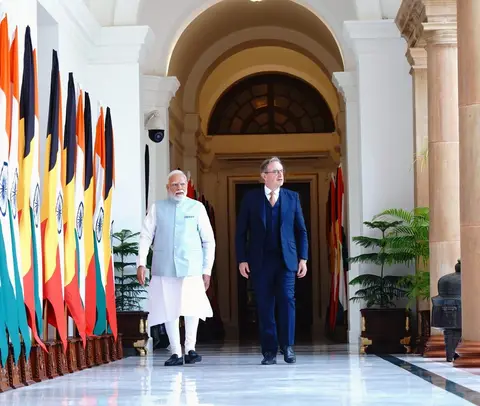 DEFENCE INDUSTRYIndia Belgium Defence Deals Sealed As PM De Wever Visits Delhi
 DEFENCE INDUSTRYAero India 2027 Dates Confirmed for February 8 to 12 in Bengaluru
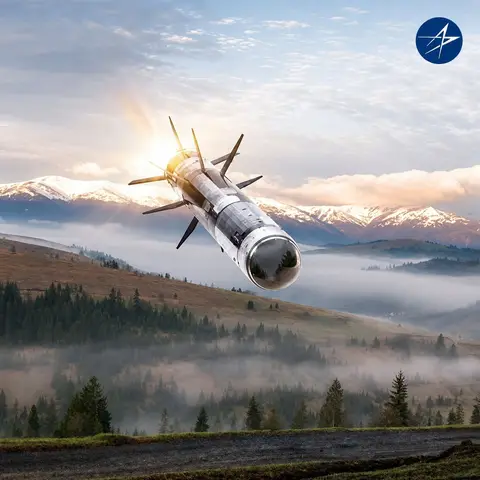 DEFENCE INDUSTRYJavelin missile co-production advances as Tata Advanced Systems signs Javelin Joint Venture pact
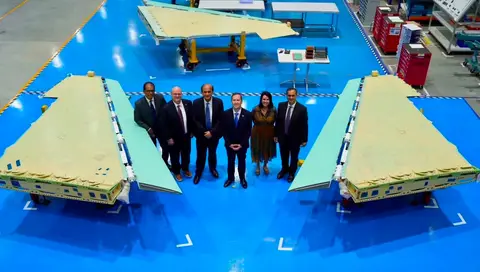 DEFENCE INDUSTRYTata Lockheed Martin MTA push gets a lift from US envoy's Hyderabad visit
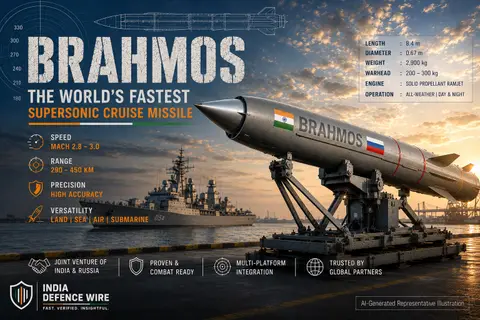
BrahMos is a supersonic cruise missile developed jointly by India's Defence Research and Development Organisation (DRDO) and Russia's NPO Mashinostroyeniya through the joint venture BrahMos Aerospace, established in 1998. Named after the Brahmaputra and Moskva rivers, it is among the fastest operational cruise missiles in the world and forms a central strike weapon across the Indian Army, Navy and Air Force.
Key facts
- Type: supersonic, ramjet-powered cruise missile
- Developer: BrahMos Aerospace, a DRDO-NPO Mashinostroyeniya joint venture (India 50.5%, Russia 49.5%)
- Speed: approximately Mach 2.8-3.0, roughly 3,700 km/h
- Range: originally capped near 290 km under missile-technology export limits; current variants extend to roughly 400-450 km, with an extended-range BrahMos-ER variant of up to 800 km cleared for procurement and under trials
- Guidance: inertial navigation with satellite mid-course update and an active radar terminal seeker
- Launch platforms: road-mobile transporter erector launchers, warships, Su-30MKI fighter aircraft, and a submarine-launched variant under development
- Status: in service with the Indian Army, Navy and Air Force; exported to the Philippines
Development
BrahMos originated from an inter-governmental agreement between India and Russia signed in February 1998, adapting technology derived from the Soviet-era P-800 Oniks anti-ship missile. The missile's first test flight took place in 2001, and the ship-launched variant entered service with the Indian Navy in 2005, followed by a land-attack version for the Army. Early export variants of BrahMos were restricted to a range of 290 km under missile-technology control commitments; India's entry into the Missile Technology Control Regime in 2016 removed that constraint, opening the way for longer-range variants.
Variants
- Land-attack and anti-ship (Block I/II/III): the original truck-launched and ship-launched versions, progressively refined for steep-dive attack and improved seeker discrimination against land and naval targets
- Air-launched BrahMos-A: a lighter version integrated with the Su-30MKI, first fired successfully in 2017, giving the Indian Air Force a long-range stand-off strike capability
- BrahMos-ER (Extended Range): a range-enhanced variant, with additional regiments cleared for procurement by India's Defence Acquisition Council
- BrahMos-NG (Next Generation): a compact, lighter version of around 1.3 tonnes, roughly a third the weight of the original, intended for smaller platforms such as the Tejas light combat aircraft
- Submarine-launched variant: under development for vertical launch from Indian Navy submarines
Capabilities and operational role
BrahMos is designed to strike land and naval targets with high precision at supersonic speed, giving targets minimal warning time and complicating interception compared with slower subsonic cruise missiles. Its terminal-phase manoeuvring and steep-dive attack profile are intended to defeat point-defence systems on ships and hardened land targets. In Indian service, BrahMos batteries have been positioned along both the western and northern borders, and the missile is regarded as a key component of India's conventional deterrence posture.
Exports
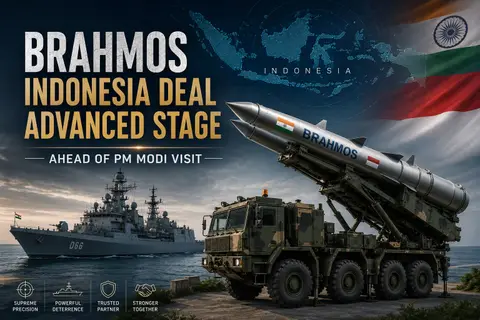
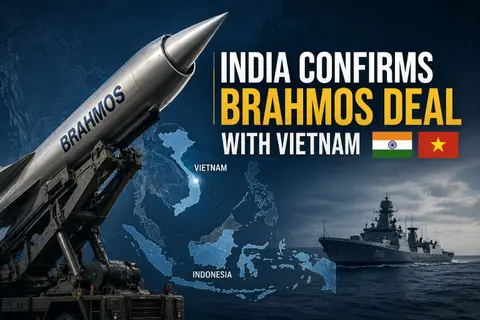
In January 2022, the Philippines signed a contract worth close to US$375 million for shore-based BrahMos anti-ship batteries, marking the missile's first export sale; deliveries began in 2024. Several other countries, including Vietnam and Indonesia, have expressed or formalised interest in acquiring the system, and BrahMos Aerospace has stated an intent to expand its export customer base significantly in the coming years.
More than two decades after its first test, BrahMos remains one of the few operational supersonic cruise missiles anywhere in the world, and continued work on extended-range, air-launched, submarine-launched and next-generation variants points to its continued centrality in India's tri-service strike capability.
Looking ahead: BrahMos-II
Beyond the current supersonic family, BrahMos Aerospace has long discussed BrahMos-II, a hypersonic follow-on concept intended to fly at speeds beyond Mach 5. Development has proceeded slowly and no confirmed induction timeline exists, but the programme signals India and Russia's ambition to extend the BrahMos partnership into the hypersonic era, in step with parallel hypersonic glide-vehicle and cruise-missile efforts elsewhere in the region.