
 INDIA DEFENCEDhruv NG Helicopter Explained: What HAL Has Actually Put Into Pawan Hans Service
 INDIA DEFENCELCA FOC Trainers Delivered With HTT 40 and Dhruv NG as Rajnath Singh Asks Engineers for Technologies That Do Not Exist
 DEFENCE INDUSTRYTata Zorawar light tank clears Army's L1 hurdle for Rs 20,000 crore contract
 DEFENCE INDUSTRYIndia Belgium Defence Deals Sealed As PM De Wever Visits Delhi
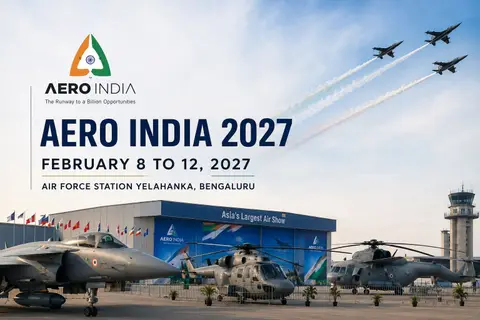 DEFENCE INDUSTRYAero India 2027 Dates Confirmed for February 8 to 12 in Bengaluru
The Indian Air Force is the aerial arm of the Indian Armed Forces, responsible for securing Indian airspace and for delivering air power in support of joint operations. Like the other services, it is organised into a set of commands, each led by an Air Officer Commanding-in-Chief of the rank of air marshal, who reports to the Chief of the Air Staff at Air Headquarters in New Delhi. This structure allows the Air Force to combine centralised control of air power with the regional management of its stations and squadrons.
The Air Force divides its commands into two categories. Five are operational commands, organised largely on a regional basis, and two are functional commands dealing with maintenance and training. This arrangement separates the direct conduct of air operations from the logistics, engineering and instruction that sustain the fleet, reflecting the principle that air power depends as much on servicing and skilled personnel as on aircraft themselves.
The operational commands
The five operational commands are the Western, Eastern, Central, South Western and Southern Air Commands. Each is responsible for air operations over a broad geographical zone and directs the flying stations, radar units and air-defence assets within it.
- Western Air Command covers the northern and north-western sectors, including the airspace over the capital region and key western frontiers.
- Eastern Air Command is oriented towards the north-eastern region and the frontier with China there.
- South Western and Southern Air Commands hold responsibility for the western desert sector and peninsular India respectively.
- Central Air Command covers the central belt and important transport and logistics hubs.
The two functional commands are the Training Command, which oversees the academies and schools that produce pilots, engineers and technicians, and the Maintenance Command, which manages depots, repair facilities and the supply of spares that keep aircraft serviceable. Together these functional commands ensure that the operational commands have both trained crews and airworthy machines.
Squadrons and stations
The basic operational unit of the Air Force is the squadron, which flies a particular type of aircraft such as a fighter, transport or helicopter fleet. Squadrons are based at air force stations, and several squadrons and supporting units may share a single station. Above the station level, operational control is exercised through the command headquarters, while air-defence radars and surface-to-air systems are integrated into a networked picture of the airspace.
The Air Force operates a mixed fleet drawn from indigenous and foreign sources, spanning multirole fighters, transport aircraft, aerial refuelling tankers, airborne early warning platforms and a large helicopter fleet. An overview of the types in service is given in the account of military aircraft of India. The maintenance of a sufficient number of fighter squadrons to meet planned strength has been a recurring theme in discussion of the Air Force's modernisation, along with the induction of indigenous aircraft and force-multipliers.
Air power is inherently joint in character, and the Air Force works closely with the Army and the Navy in support of land and maritime operations, providing close support, airlift, reconnaissance and air defence. The Air Force also contributes to India's deterrent posture, with air-delivered systems forming one leg of the nuclear triad coordinated through the Strategic Forces Command.
The higher organisation of the Air Force is being influenced by the wider defence reforms driven by the office of the Chief of Defence Staff. The proposed move towards integrated theatre commands would see air assets allocated to joint theatre structures, and the balance between such theatre commands and the Air Force's existing functional commands remains an area under active discussion as the reform is implemented. How best to apportion a relatively scarce and highly mobile resource like air power across theatres is one of the central questions the reform must resolve.