
 DEFENCE INDUSTRYBrahMos export orders: Vietnam deal worth about $100 million, Indonesia $200 million as Akash reaches Tajikistan, Turkmenistan
 DEFENCE INDUSTRYMahindra Embraer Nagpur facility to assemble C-390 if IAF picks the aircraft
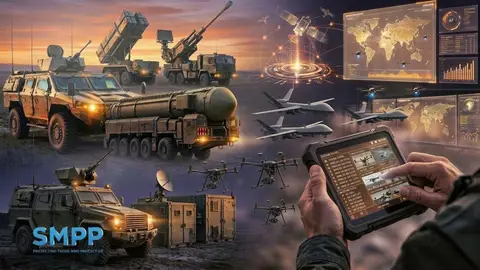 DEFENCE INDUSTRYSMPP Drone Manufacturing Push: Firm Shifts From Ammunition to Unmanned Warfare, Targets Integrated Defence Capabilities
 INDIA DEFENCEDhruv NG Helicopter Explained: What HAL Has Actually Put Into Pawan Hans Service
 INDIA DEFENCELCA FOC Trainers Delivered With HTT 40 and Dhruv NG as Rajnath Singh Asks Engineers for Technologies That Do Not Exist
Behind every capable tank lies a constant contest between armour and ammunition, and India has invested steadily in both. The DRDO and allied laboratories have developed indigenous armour packages and gun munitions to equip the fleets of the Indian Army, reducing dependence on imports for these critical, consumable and often export-controlled items. The best known Indian contribution is the composite armour developed under the name Kanchan, associated with the Arjun main battle tank, which demonstrated that India could design protection to a high standard at home.
These technologies are not static. As anti-tank weapons improve, so do the protective packages designed to defeat them, and the rounds designed to defeat those packages in turn. Armour and ammunition therefore remain a continuing area of research rather than a solved problem, and mastery of both is a mark of a mature armour industry. For India, indigenous capability in these fields is also a matter of strategic autonomy, since these items cannot easily be stockpiled from foreign sources in a crisis.
Armour technology
Modern tank protection combines several complementary approaches rather than relying on thick steel alone. Composite armour, such as Kanchan, layers metals and ceramics to defeat both kinetic penetrators and shaped-charge warheads more efficiently by weight than homogeneous steel. Explosive reactive armour adds bricks or tiles that detonate outward to disrupt incoming jets and penetrators, and is widely fitted to Indian tanks as an affordable way to boost protection. Increasingly, attention is turning to active protection concepts that detect and intercept threats before they strike the vehicle.
- Composite armour combining metals and ceramics (Kanchan)
- Explosive reactive armour fitted to in-service fleets
- Growing interest in active protection against missiles and top-attack threats
- Spall liners and improved internal protection for the crew
- Continuous adaptation as anti-tank weapons evolve
These protective advances feed directly into platform programmes, from the upgraded T-90 Bhishma to the lighter Zorawar light tank, where clever armour design helps offset reduced mass and preserve survivability in a smaller, lighter vehicle.
A recurring theme in armour design is the trade-off between protection, mobility and cost. Adding armour increases weight, which strains the engine, transmission and suspension and reduces strategic mobility, while active protection and advanced materials add expense and complexity. Designers must therefore balance these factors for each vehicle and each expected threat, which is why the protection package of a heavy main battle tank differs so markedly from that of a light or amphibious vehicle designed for different tasks.
Gun ammunition
On the offensive side, the armour-piercing fin-stabilised discarding-sabot (APFSDS) round is the primary kinetic anti-tank projectile fired by modern tank guns, using a dense, high-velocity dart to punch through armour. India has developed indigenous APFSDS ammunition to arm its T-72, T-90 and Arjun tanks, an effort important both for operational readiness and for reducing reliance on foreign suppliers of a round consumed in large quantities during training and conflict. Tanks also fire high-explosive and other natures for engaging fortifications, infantry and soft targets, and can employ gun-launched or vehicle-mounted anti-tank missiles such as the Nag family of anti-tank missiles to extend their reach.
Production of armour and ammunition is anchored in India's industrial base, including Armoured Vehicles Nigam Limited and the wider ordnance and munitions ecosystem, which must manufacture these items reliably and at scale. Mastery of these technologies underpins every current and future Indian tank, from the T-90 to the planned Future Ready Combat Vehicle, whose survivability and lethality will depend heavily on the armour and rounds it carries.
For the platforms these systems protect and arm, see the overview of tanks used by India, where armour and ammunition are the invisible but decisive measures of combat power. It is often these unseen technologies, as much as the visible shape of a tank, that determine which side prevails in an armoured engagement.