
 DEFENCE INDUSTRYBrahMos export orders: Vietnam deal worth about $100 million, Indonesia $200 million as Akash reaches Tajikistan, Turkmenistan
 DEFENCE INDUSTRYMahindra Embraer Nagpur facility to assemble C-390 if IAF picks the aircraft
 DEFENCE INDUSTRYSMPP Drone Manufacturing Push: Firm Shifts From Ammunition to Unmanned Warfare, Targets Integrated Defence Capabilities
 INDIA DEFENCEDhruv NG Helicopter Explained: What HAL Has Actually Put Into Pawan Hans Service
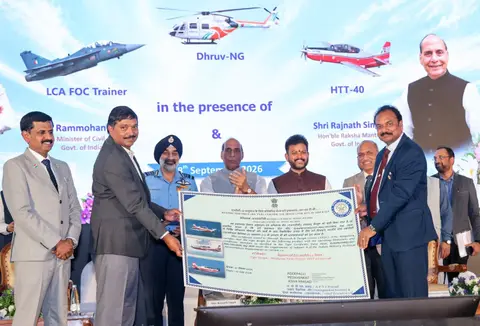 INDIA DEFENCELCA FOC Trainers Delivered With HTT 40 and Dhruv NG as Rajnath Singh Asks Engineers for Technologies That Do Not Exist
The Future Ready Combat Vehicle (FRCV) is a long-term Indian Army programme conceived to develop a next-generation main battle tank platform. It is intended to eventually replace the large fleet of ageing T-72 tanks that has formed the backbone of India's armoured corps for decades. The FRCV is envisaged not as a single vehicle but as a modular family built on a common platform, allowing variants for direct fire, engineering support, recovery and other roles to be developed as requirements evolve. This approach mirrors international trends toward common chassis families and reflects hard lessons from operating a fleet made up of many unrelated types.
As with any programme of this scale, the FRCV is best understood as a capability still under development. Broad requirements have been articulated by the Indian Army, and the effort is being pursued under the Make in India framework with domestic industry expected to play a central role. Precise configurations, numbers and timelines remain subject to trials, negotiation and evolving doctrine, so figures reported in the press should be treated as provisional. What is clear is the intent: a home-grown platform designed from the outset around Indian operating conditions and industrial capability rather than adapted from a foreign design.
Design philosophy and requirements
The FRCV is framed around a set of attributes the Army considers essential for future armoured warfare. The requirement is shaped by the changing character of the battlefield, where tanks must contend not only with other armour and anti-tank guided missiles but increasingly with top-attack munitions, loitering drones and dense electronic threats. Commonly cited priorities therefore include enhanced survivability, high strategic and tactical mobility, networked situational awareness, and the ability to integrate active protection systems, modern fire control and future upgrades over a long service life.
- A common, upgradeable platform supporting multiple variants
- Improved crew protection with active, reactive and composite armour options
- Modern sensors, fire control and battlefield networking
- Room for growth so the design remains relevant for decades
- High indigenous content and domestic manufacturing under Make in India
The emphasis on a modular common platform reflects a desire to avoid the fragmentation of maintaining many unrelated vehicle types, a challenge familiar from India's mixed fleet of imported and licence-built armour. A single logistical and training base for a family of vehicles promises lower life-cycle costs and simpler support in the field.
These aims connect the FRCV to wider national efforts in armour and firepower. Work on protection and munitions carried out for other platforms, described in tank ammunition and armour technology, is expected to inform the FRCV, as are the practical lessons from operating and progressively upgrading the T-90 Bhishma, which forms the modern heart of the fleet today.
Programme context and industry
The FRCV sits within a broader modernisation picture in which India seeks to reduce dependence on imports and build sovereign design capability in complex armoured systems. Domestic defence public sector undertakings such as Armoured Vehicles Nigam Limited, together with private industry, are positioned to contribute to development and eventual production, supported by the research base of the DRDO. The programme is widely seen as a test of whether India can design and field a world-class main battle tank largely on its own terms.
Because it is a paper programme moving toward realisation, the FRCV should be read alongside India's other tank efforts rather than in isolation. The lighter, high-altitude Zorawar light tank addresses mountain warfare needs that a heavy main battle tank cannot easily meet, while the FRCV is meant to dominate the plains and desert sectors where mass armoured formations operate. Together these programmes illustrate a deliberate move toward a tiered armoured fleet, each element tuned to a different theatre and threat.
For readers tracing how the FRCV fits into the country's overall armour inventory, the category overview of tanks used by India provides the broader lineage from the Vijayanta and T-55 through the T-72, T-90 and Arjun. The FRCV represents the intended next chapter in that story: an indigenously designed platform meant to carry India's armoured corps well into the middle of the century, though its final shape will be determined by the trials and decisions that still lie ahead.