
 DEFENCE INDUSTRYBrahMos export orders: Vietnam deal worth about $100 million, Indonesia $200 million as Akash reaches Tajikistan, Turkmenistan
 DEFENCE INDUSTRYMahindra Embraer Nagpur facility to assemble C-390 if IAF picks the aircraft
 DEFENCE INDUSTRYSMPP Drone Manufacturing Push: Firm Shifts From Ammunition to Unmanned Warfare, Targets Integrated Defence Capabilities
 INDIA DEFENCEDhruv NG Helicopter Explained: What HAL Has Actually Put Into Pawan Hans Service
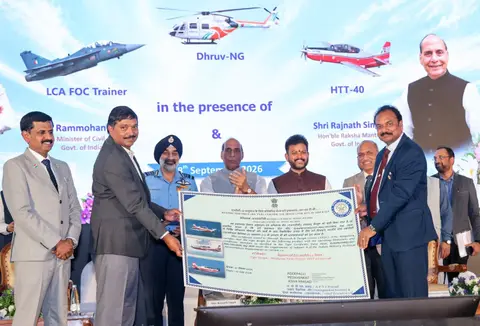 INDIA DEFENCELCA FOC Trainers Delivered With HTT 40 and Dhruv NG as Rajnath Singh Asks Engineers for Technologies That Do Not Exist
The Armoured Corps Centre and School (ACC&S) at Ahmednagar in Maharashtra is the principal training and doctrine institution for the armoured corps of the Indian Army. It is where the corps trains its tank crews, instructs officers in the theory and practice of armoured warfare, and helps develop the tactics and procedures that govern how India employs its tanks. Ahmednagar has a long association with mechanised soldiering, and the establishment is widely regarded as the spiritual home of India's tank arm.
As a centre of excellence, ACC&S combines individual and crew training with the higher study of armoured tactics, ensuring that the human element keeps pace with the machines. This matters because a tank is only as good as the crew that fights it: well-trained crews and sound doctrine are as important to armoured effectiveness as the vehicles themselves, and often decide the outcome of an engagement between broadly comparable forces.
Training and doctrine
The school's work spans the full range of skills an armoured soldier needs, from driving and gunnery to communications, maintenance and the command of armoured sub-units in the field. Officers and other ranks pass through Ahmednagar to learn their trade at the start of their careers and to return for advanced courses as they rise, keeping abreast of new equipment, tactics and evolving threats.
- Basic and advanced training for tank crews and armoured officers
- Development and dissemination of armoured warfare tactics and doctrine
- Conversion training as new platforms and upgrades enter service
- Instruction in gunnery, driving, communications and maintenance
- A repository of institutional knowledge for the whole corps
As modern platforms arrive, the school adapts its syllabus accordingly. The induction of upgraded tanks such as the T-90 Bhishma and new categories like the Zorawar light tank requires fresh training packages, simulators and procedures so that crews can exploit their capabilities fully from the moment they reach their units.
Modern armoured training increasingly blends field practice with simulation. Simulators allow crews to rehearse gunnery, driving and tactical decision-making safely and economically, conserving the running hours and ammunition of expensive vehicles while still building skill. Institutions like Ahmednagar therefore combine hands-on instruction with classroom study and simulated exercises, producing crews and commanders who are ready to operate as effective teams under the stresses of battle.
Heritage and wider role
Ahmednagar is also home to the Cavalry Tank Museum, one of the notable collections of armoured vehicles in Asia, which preserves the heritage of Indian and foreign armour and connects serving soldiers to the history of their arm. This sense of tradition, rooted in the corps' cavalry lineage and its battle honours, sits alongside the school's forward-looking role in preparing the corps for future warfare. The blend of heritage and modernity is characteristic of the armoured corps as a whole, and the museum serves both to educate the public and to instil pride and esprit de corps in those under training.
Doctrine development is a further important function. As the character of armoured warfare changes, the school studies lessons from exercises and from conflicts around the world, and helps codify how India should fight with its tanks. This intellectual work, turning experience and analysis into agreed tactics and procedures, is what allows a large and dispersed corps to fight in a consistent and coordinated way.
The training conducted at ACC&S ultimately feeds the operational strength of India's armoured divisions and regiments, whose crews are formed and refined here before joining their units in the field. The quality of that training is a direct input to the fighting power of the corps, and the school works closely with the wider force to ensure that lessons from exercises and operations flow back into the syllabus.
As India moves toward next-generation platforms such as the Future Ready Combat Vehicle, institutions like Ahmednagar will be central to translating new hardware into battlefield capability, developing the crews and concepts needed to use it well. For context on the machines these crews operate, see the overview of tanks used by India.