
 DEFENCE INDUSTRYBrahMos export orders: Vietnam deal worth about $100 million, Indonesia $200 million as Akash reaches Tajikistan, Turkmenistan
 DEFENCE INDUSTRYMahindra Embraer Nagpur facility to assemble C-390 if IAF picks the aircraft
 DEFENCE INDUSTRYSMPP Drone Manufacturing Push: Firm Shifts From Ammunition to Unmanned Warfare, Targets Integrated Defence Capabilities
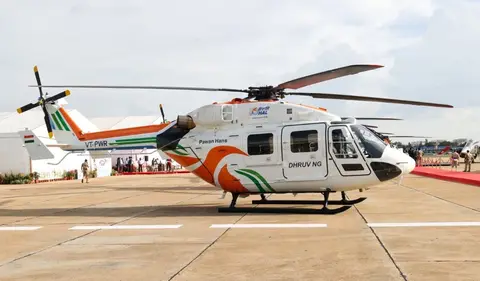 INDIA DEFENCEDhruv NG Helicopter Explained: What HAL Has Actually Put Into Pawan Hans Service
 INDIA DEFENCELCA FOC Trainers Delivered With HTT 40 and Dhruv NG as Rajnath Singh Asks Engineers for Technologies That Do Not Exist
The armoured corps forms the mailed fist of the Indian Army, providing the concentrated firepower, mobility and shock action on which offensive operations depend. Its tanks are organised into a hierarchy of regiments, brigades and divisions designed to deliver massed armour at the decisive point. Understanding this structure helps explain how India translates a large tank fleet into coherent battlefield capability, rather than simply a collection of vehicles.
The Indian armoured corps traces its lineage to the cavalry of the past, and many of its regiments carry historic names, traditions and battle honours earned over more than a century. Today those traditions are married to modern tanks, sensors and communications in formations built for fast-moving combined-arms warfare. The corps prides itself on its offensive spirit, a legacy of its mounted origins now expressed through armour.
Organisational structure
The basic building block is the armoured regiment, roughly equivalent to a battalion in other arms, which fields a number of tanks organised into squadrons and troops under a commanding officer. Regiments combine with mechanised infantry, artillery, engineers and other supporting arms to form armoured brigades, and several brigades together with their supporting elements make up an armoured division, the largest predominantly armoured formation in the Army.
- The armoured regiment as the basic tank unit, organised into squadrons and troops
- Armoured brigades combining tanks with mechanised infantry and support
- Armoured divisions as the principal offensive formations
- Independent armoured brigades attached to other corps
- Reconnaissance and support units integral to the corps
Armoured divisions typically form the core of the Army's strike corps, the formations held ready for decisive offensive operations, while independent armoured brigades add punch to holding formations along the borders. This layered structure lets commanders concentrate armour where it is needed while still providing armoured support across the front. The tanks equipping these units are drawn from the fleet surveyed in the overview of tanks used by India, principally the T-90 Bhishma, the T-72 and the indigenous Arjun.
People, equipment and the future
An armoured formation is far more than its tanks. It depends on the crews trained at institutions such as the Armoured Corps Centre and School at Ahmednagar, on the mechanised infantry riding in vehicles like the BMP-2 Sarath, and on the engineers operating bridge-laying and combat engineering vehicles that keep the advance moving across obstacles. Artillery, air defence, signals and logistics all contribute to making an armoured formation a self-contained, hard-hitting team capable of independent action.
Deployment reflects geography and threat. Heavy armoured formations are oriented toward the plains and deserts of the western sector, where their mobility and firepower can be used to full effect, while lighter capabilities are being developed for the mountainous north, where terrain constrains conventional armour. This distribution shapes where India stations its divisions and how it equips them for their likely theatres of operation.
The armoured corps does not fight alone. Its effectiveness rests on close cooperation with the other arms and with the air force, and on the sustained flow of fuel, ammunition and spares that armoured operations consume at a prodigious rate. Commanders must weigh the striking power of massed armour against the logistical tail it demands, and the corps continually refines its concepts through exercises to keep pace with changing technology, from precision weapons to unmanned systems that now shadow the battlefield.
As new platforms such as the planned Future Ready Combat Vehicle enter the force, the organisation of India's armoured divisions and regiments will continue to adapt to new technologies and doctrines. Yet their central purpose, to concentrate armoured power decisively at the point of decision, endures as the guiding principle of the corps and the reason it remains the Army's principal instrument of offensive action.